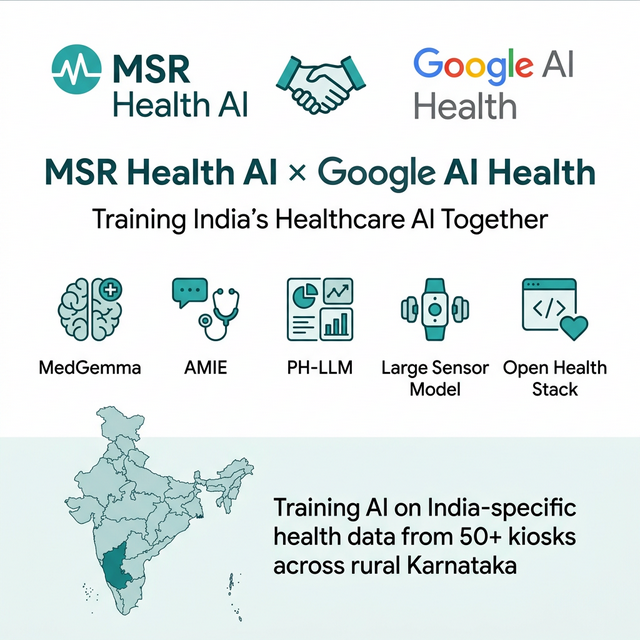
Training India's Healthcare AI under the MSR-Ramaiah umbrella — leveraging Google's most powerful medical AI models to build India-specific healthcare intelligence from real kiosk diagnostic data.
Visit Google AI Health ↗
MSR Health AI will officially partner with Google AI Health to train and deploy healthcare AI models specifically for India. With data from 50+ kiosks across rural Karnataka feeding real-world health parameters — blood pressure, ECG, blood glucose, cholesterol from millions of screenings — we will fine-tune Google's most powerful medical AI models for Indian demographics, diseases, and languages.
Google already partners with Apollo Hospitals for TB screening across India. MSR Health AI extends this to comprehensive rural diagnostics — covering cardiovascular disease, diabetes, obesity, anemia, and mental health — the diseases that kill the most Indians.
Why MSR? No other AI health kiosk company in India has a 1,900+ bed hospital ecosystem + 50 kiosks generating real diagnostic data + a medical university for clinical validation. This makes MSR the ideal partner for training India-centric healthcare AI.
The most advanced medical AI models in the world — now being trained on India-specific diagnostic data from MSR kiosks.
Open-Weight Medical AI Model
Google's most capable open model for multimodal medical text and image comprehension. MedGemma understands clinical notes, medical images (X-rays, dermatology, pathology), and diagnostic reports. MSR will fine-tune MedGemma on Indian clinical data — ECG patterns prevalent in South Asian hearts, diabetes patterns specific to Indian diets, and rural disease profiles distinct from Western training datasets.
MSR Application: AI-powered health reports, diagnostic risk scoring, medical image analysis, multilingual report generation in Kannada/Hindi/English.
Conversational Clinical AI
An experimental AI system combining clinical reasoning with conversational empathy. AMIE can conduct diagnostic conversations, follow up on symptoms, and guide pre-consultation assessments. For MSR kiosks, this powers the Kannada-first AI chatbot that guides patients through the screening process — asking relevant questions, explaining results, and identifying when emergency escalation is needed.
MSR Application: AI health chatbot in Kannada/Hindi/English, symptom pre-screening, chronic disease management reminders, emergency triage.
Gemini Fine-Tuned for Health Data
A version of Google's Gemini model fine-tuned specifically for health and wellness data. PH-LLM interprets complex data from kiosk sensors — body composition, cardiovascular profiles, metabolic panels — and translates them into actionable, personalized health insights. It helps users understand their health trajectory over multiple visits, set realistic goals, and make informed decisions.
MSR Application: Personalized health reports, multi-visit trend analysis, goal setting, medication adherence tracking.
Largest Wearable/Sensor AI Model
Trained on the largest dataset of its kind to decode signals from kiosk sensors — heart rate variability, ECG waveforms, SpO₂ patterns, and BIA body composition signals — with remarkable accuracy. LSM can detect subtle anomalies in sensor data that traditional algorithms miss, enabling pre-symptomatic disease detection from kiosk data alone.
MSR Application: ECG arrhythmia detection, SpO₂ trend anomalies, BIA interpretation, pre-symptomatic disease alerts.
Open-Source FHIR Building Blocks
A suite of open-source building blocks built on the FHIR R4 interoperable data standard. Open Health Stack makes it easier to build apps that work offline, share health data across systems (ABDM/ABHA), and function in areas with unreliable internet — exactly the conditions MSR kiosks operate in across rural Karnataka.
MSR Application: ABDM/ABHA integration, offline kiosk operation, FHIR-compliant health records, cross-system data sharing.
Western AI models fail Indian patients. MSR + Google AI Health will build India-specific models from real diagnostic data.
South Asian hearts have distinct ECG patterns — shorter QT intervals, different ST-segment baselines, and higher prevalence of premature coronary disease. Our kiosk ECGs will train AI to recognize these India-specific cardiac signatures, reducing false positives and catching conditions that Western-trained models miss.
India has 77M diabetics — projected 134M by 2045. Indian diabetes presents at lower BMI than Western populations. Our kiosk glucose + HbA1c + body composition data will train predictive models calibrated for Indian diets, genetics, and lifestyle patterns — detecting pre-diabetes years earlier.
50%+ of Indian women are anemic — most undiagnosed in rural areas. Non-invasive hemoglobin from our kiosks will train models to detect anemia severity from patterns invisible to standard tests, enabling mass screening without blood draws.
56M Indians have depression — kiosk removes stigma with private AI-driven PHQ-9 screening. Our data will train culturally-calibrated mental health models that understand rural Indian stress patterns, social contexts, and regional language expressions of distress.