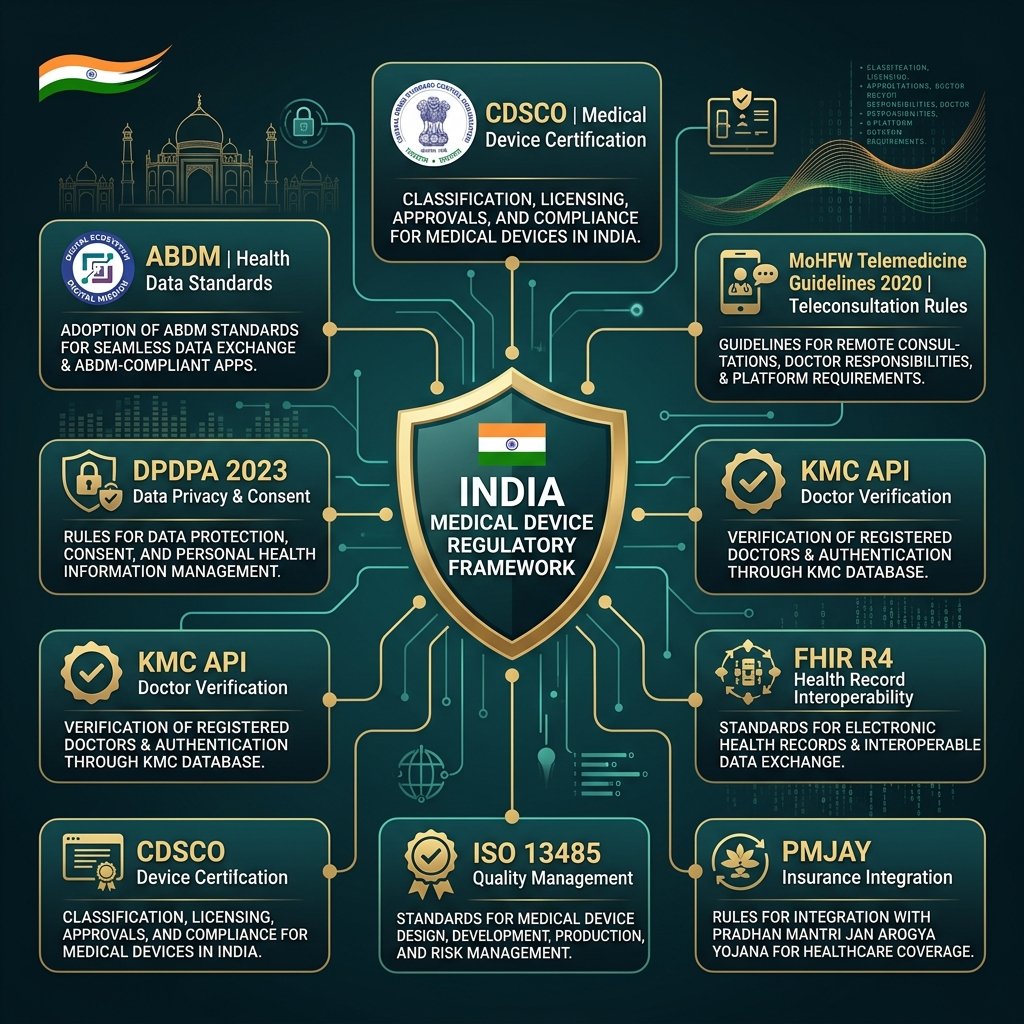
Prana MSR Health is built from the ground up to comply with CDSCO regulations, MoHFW Telemedicine Guidelines 2020, ABDM data standards, DPDPA 2023 frameworks โ and now backed by a comprehensive MedAI Patent Landscape Report securing our technological moat across 6 jurisdictions.
Ensuring medical device safety, calibration, and legal import compliance.
Fully integrated with India's Ayushman Bharat Digital Mission and data privacy laws.
Prana MSR Health operates within a comprehensive Indian regulatory framework spanning device safety, digital health infrastructure, telemedicine, and data privacy โ ensuring every module is audit-ready.
Under the Medical Devices Rules 2017 (as amended), AI-powered CDSS modules are classified as Software as a Medical Device (SaMD).
Full compliance with MoHFW Telemedicine Practice Guidelines 2020 and Indian Medical Council (Professional Conduct) Regulations.
Built-in compliance with the Digital Personal Data Protection Act 2023 (DPDPA) and India's data localisation requirements.
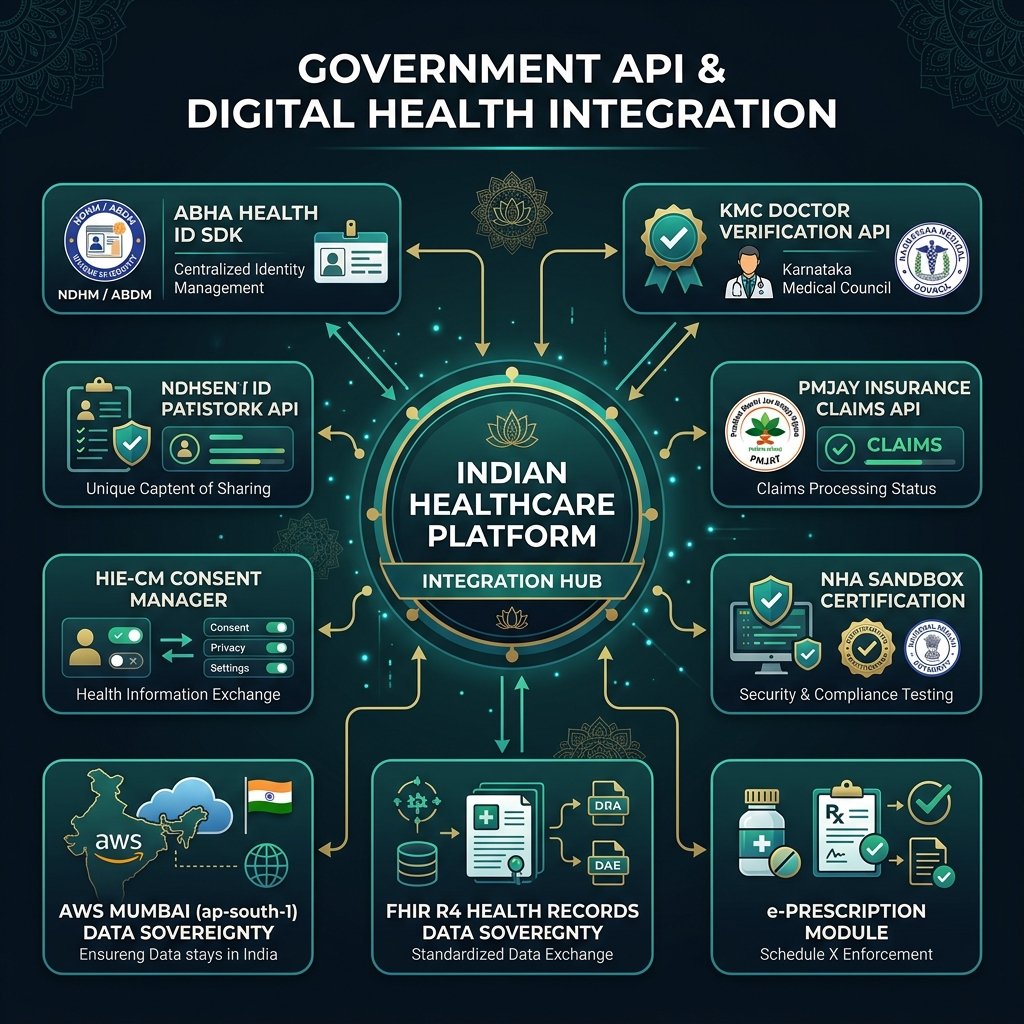
Prana MSR Health platform connects natively with India's Digital Public Infrastructure through certified APIs and sandbox-approved integrations.
Medical Device QMS
OEM CompliantInformation Security
Phase 2Medical Software Lifecycle
PlannedUsability Engineering
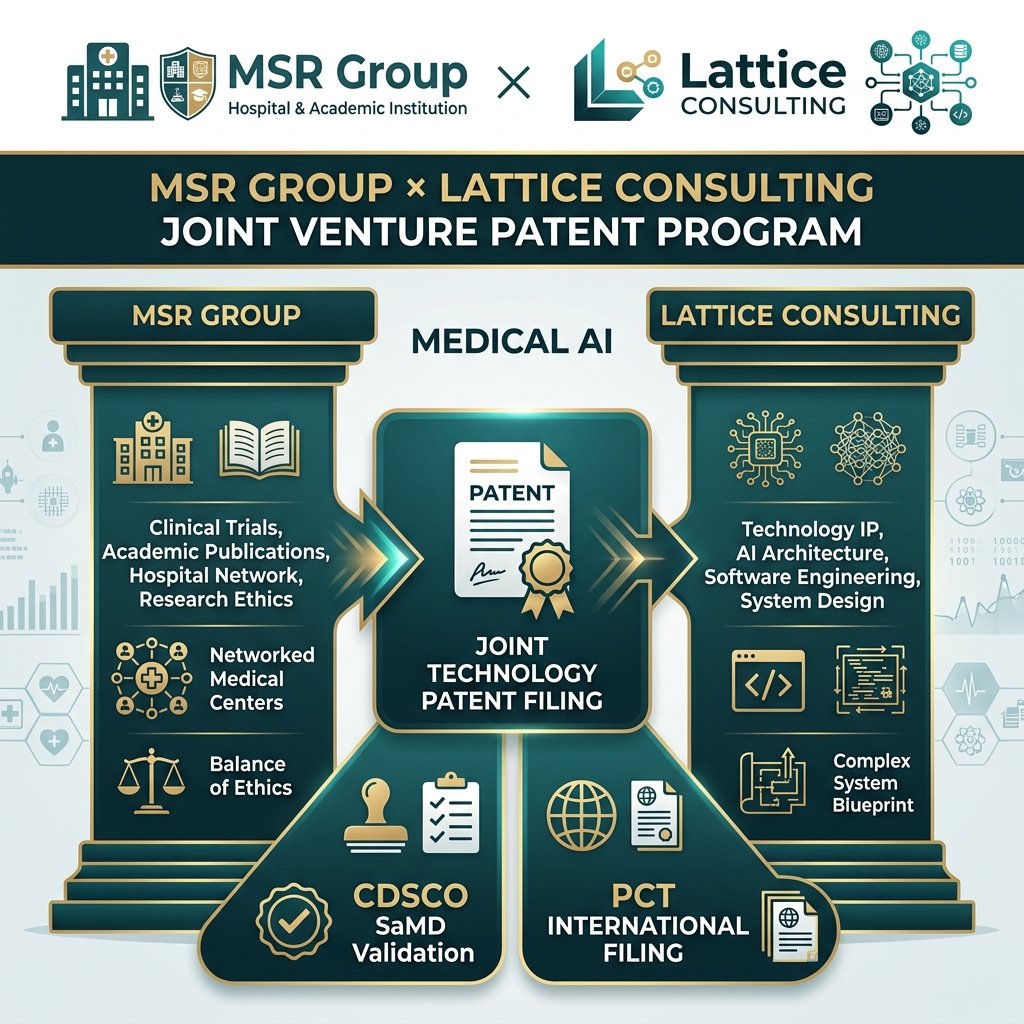
PlannedAll technology patents for the MedAI platform are filed jointly by M.S. Ramaiah Group and Lattice Consulting Worldwide (OPC) Pvt Ltd โ combining clinical authority with technology innovation.
Hospital Network & Academic Institution
MSR Group serves as the clinical validation partner, providing hospital infrastructure, patient datasets, ethics board access, and academic credibility through M.S. Ramaiah Medical College.
Technology & Software Engineering
Lattice Consulting serves as the technology IP owner, responsible for all AI architecture, system design, software engineering, and patent claim drafting for the MedAI platform.
MSR Hospital Network conducts clinical validation studies, publishes peer-reviewed academic papers, and provides real-world evidence for patent claims. All publications bear MSR Group as lead institution.
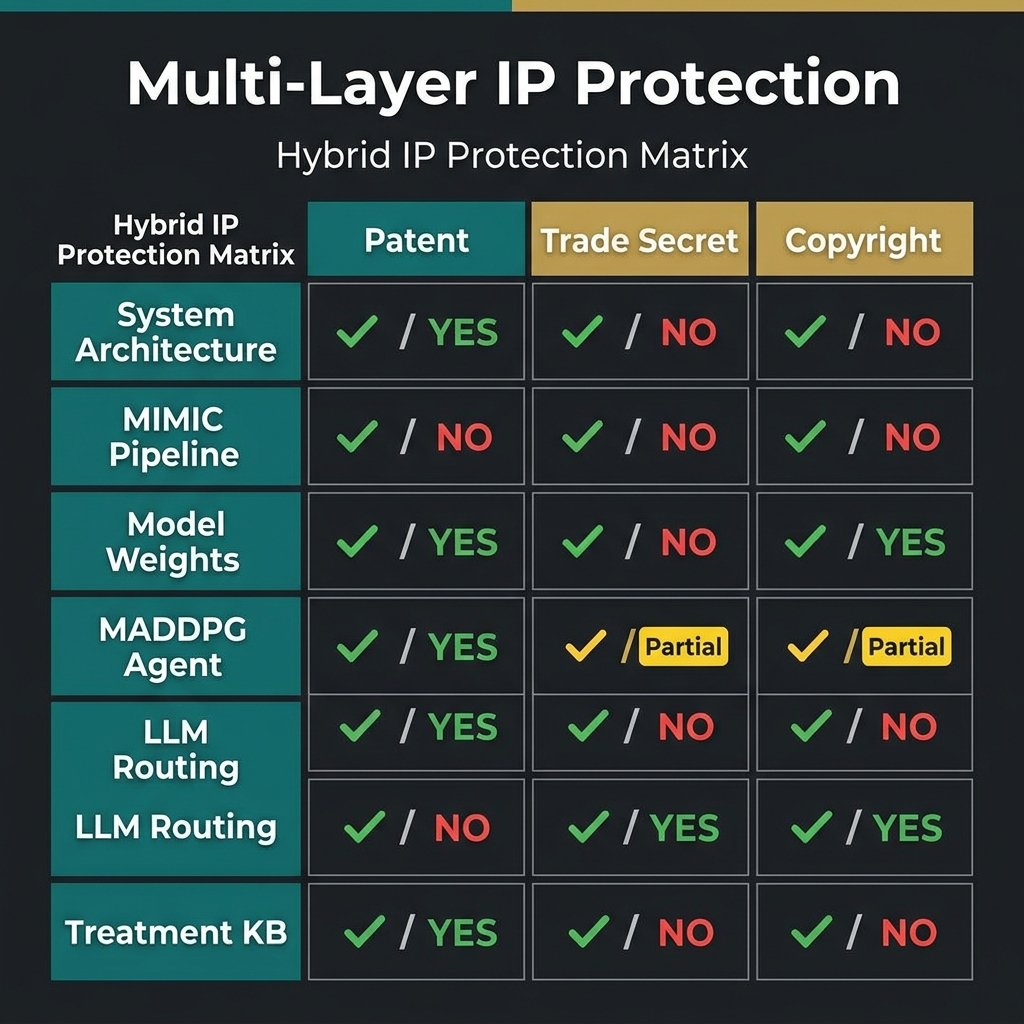
All technology patents โ system architecture, AI modules, simulation engine, LLM routing โ are filed jointly by MSR Group and Lattice Consulting as co-applicants under Indian Patents Act.
Source code copyright, model weights (trade secret), training pipelines, and system design documentation are owned by Lattice Consulting with perpetual license to MSR Group for clinical deployment.
MIMIC-IV retrospective validation published through MSR Medical College. Establishes baseline performance metrics for patent efficacy claims.
Multi-site prospective validation across MSR Hospital network (5 rural Karnataka sites). IEC-approved protocol with real patient cohorts.
Academic publication in indexed medical journals (BMJ Digital Health, JMIR) with MSR Group as institutional lead and Lattice as technology partner.
A comprehensive prior art search, freedom-to-operate analysis, and patentability assessment for the MedAI Platform โ filed jointly by MSR Group ร Lattice Consulting covering 6 technology clusters across India, USA, Europe, China, and PCT jurisdictions.
While individual technology components of MedAI (XGBoost triage, BiLSTM sepsis detection, etc.) have extensive prior art, the platform's UNIQUE VALUE lies in its integrated architecture: seven microservices operating as a single clinical continuum, powered by a real-time hospital simulation engine (HospitalEventEngine), a privacy-first local LLM layer, and MADDPG-based multi-agent hospital operations โ all trained on MIMIC-IV and India-contextualised for CDSCO SaMD compliance. This integration is the patentable novel contribution.
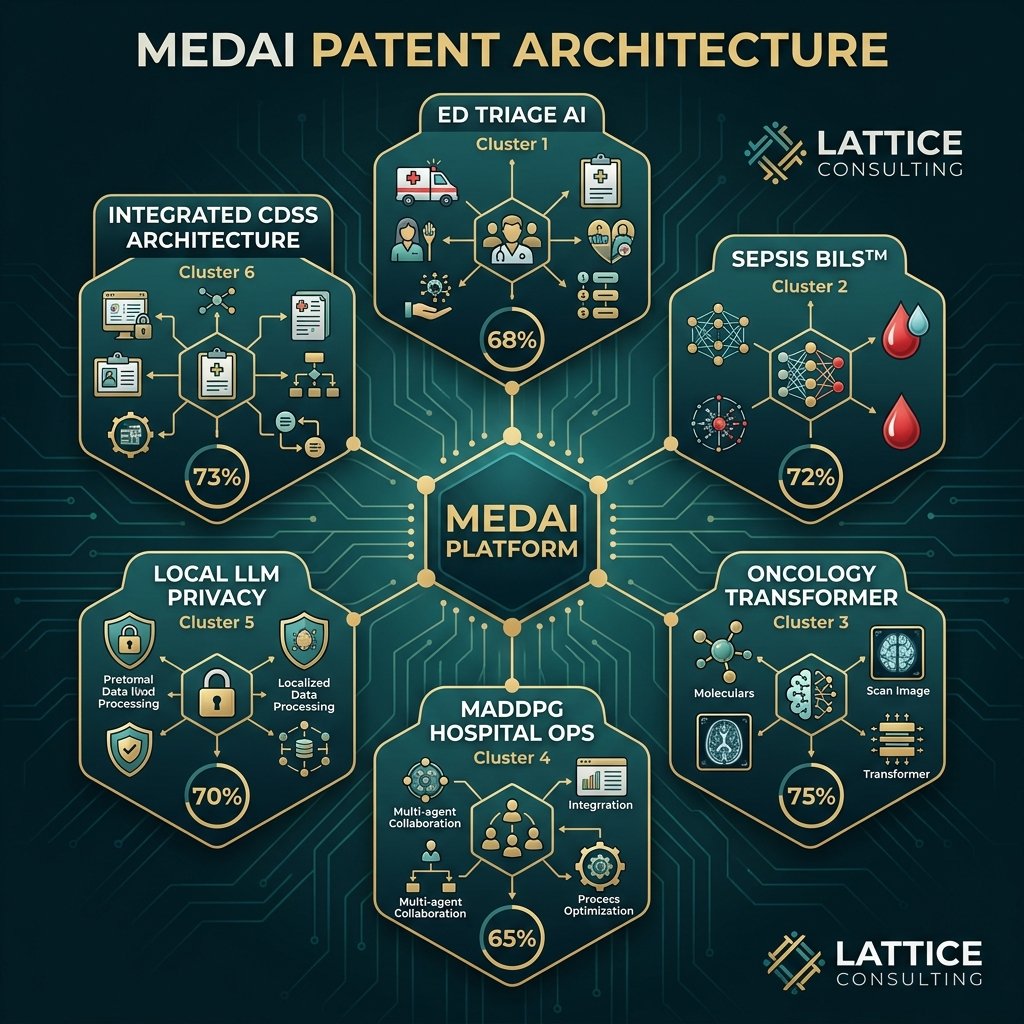
Each cluster represents a distinct, patent-eligible innovation within the MedAI platform.
TriageXGBoost + TriageNN with a 59-feature pipeline trained on MIMIC-IV. Includes missingness-aware feature engineering, arrival-mode one-hot encoding, and confidence-weighted disposition routing.
Bidirectional LSTM with temporal attention over 6-hour sliding clinical windows. 19-variable ร 6-aggregation (114 features) coupled with SOFA score integration and heuristic fallback.
Dual-task: 30-day readmission + in-hospital mortality using shared 16-feature MIMIC-IV vector. Combined risk score (0.6รreadmission + 0.4รmortality) with NCCN-aligned treatment pathway generation.
8-department RL agents with centralised critic network, curriculum learning (ED โ ED+ICU+Medicine โ All 8 departments), Ornstein-Uhlenbeck noise, powered by HospitalEventEngine replaying MIMIC patient journeys.
Ollama-hosted local LLM with zero data egress. Per-session memory, smart query intent routing to ED Triage / Oncology / Patient Journey APIs, ABDM-linked patient identity integration.
7-microservice monorepo, unified dashboard, ABDM integration, CDSCO SaMD Class B/C. System-level patents are hardest to design around and provide the broadest commercial protection.
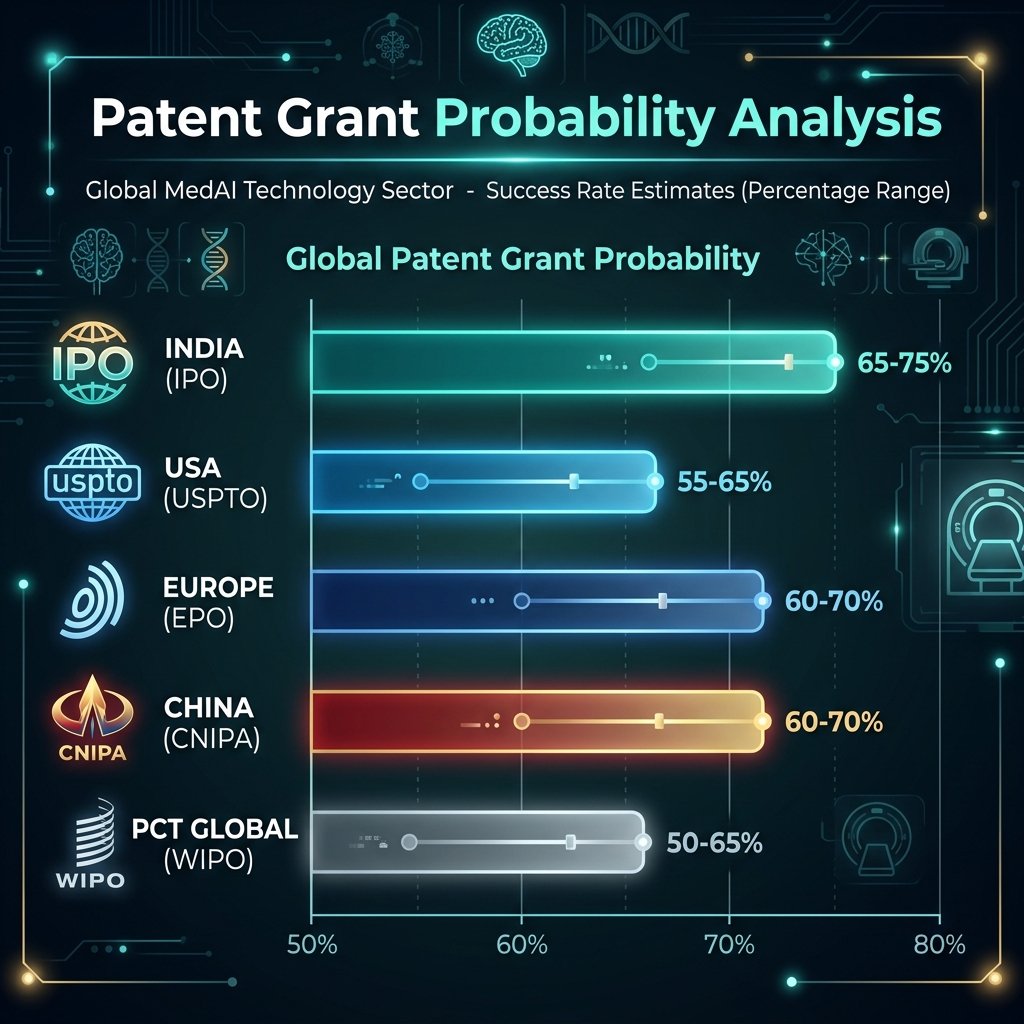
Structured assessment across India (IPO/CRI 2025), USA (USPTO/Alice-Mayo), Europe (EPO), China (CNIPA), and PCT filing routes.
The CRI Guidelines 2025 (effective July 29, 2025) fundamentally changed how AI/ML inventions are examined. Technical effect must be demonstrated โ MedAI satisfies this with quantifiable clinical outcomes (mis-triage reduction, sepsis detection time, readmission rates).
Must overcome Alice/Mayo two-step: claims cannot be directed to abstract ideas. Strategy: follow McRO/Enfish/Bascom line โ frame claims around specific technical improvements including NVIDIA GPU, MongoDB, Ollama inference hardware elements.
Uses 'technical character' and 'technical contribution' framework โ the most rigorous but also most predictable. EPO has granted numerous AI medical device patents where technical problem and solution are well-defined.
CNIPA has relatively strong AI patent grant rates. PCT filing through Indian Patent Office allows global protection via single application, with national phase entry in 150+ countries after 30 months.
Specific novel elements identified as non-obvious and industrially applicable.
"An Integrated Clinical Decision Support System Comprising Heterogeneous AI Modules, Real-Time Hospital Simulation, and Privacy-Preserving Local LLM Interface for Healthcare Facilities"
Co-Applicants: M.S. Ramaiah Group (Clinical Validation & Academic Publications) + Lattice Consulting Worldwide (Technology IP & System Architecture)
Method comprising binary missingness indicator features for vital signs/labs, one-hot patient arrival mode encoding, gradient-boosted 5-level acuity classification with confidence scoring and disposition routing.
Computer-implemented method: 6-hour ICU windows, 6 statistical aggregations per variable producing 114 features, bidirectional LSTM with temporal attention, SOFA score overlay for clinical escalation.
Transformer encoder with learned positional embeddings, two independent prediction heads (readmission + mortality), combined risk score, and personalised oncology care pathway generator.
Plurality of RL agents per department, centralised critic with concatenated observations, curriculum learning protocol, reward function combining wait time minimisation + overcrowding penalty + throughput.
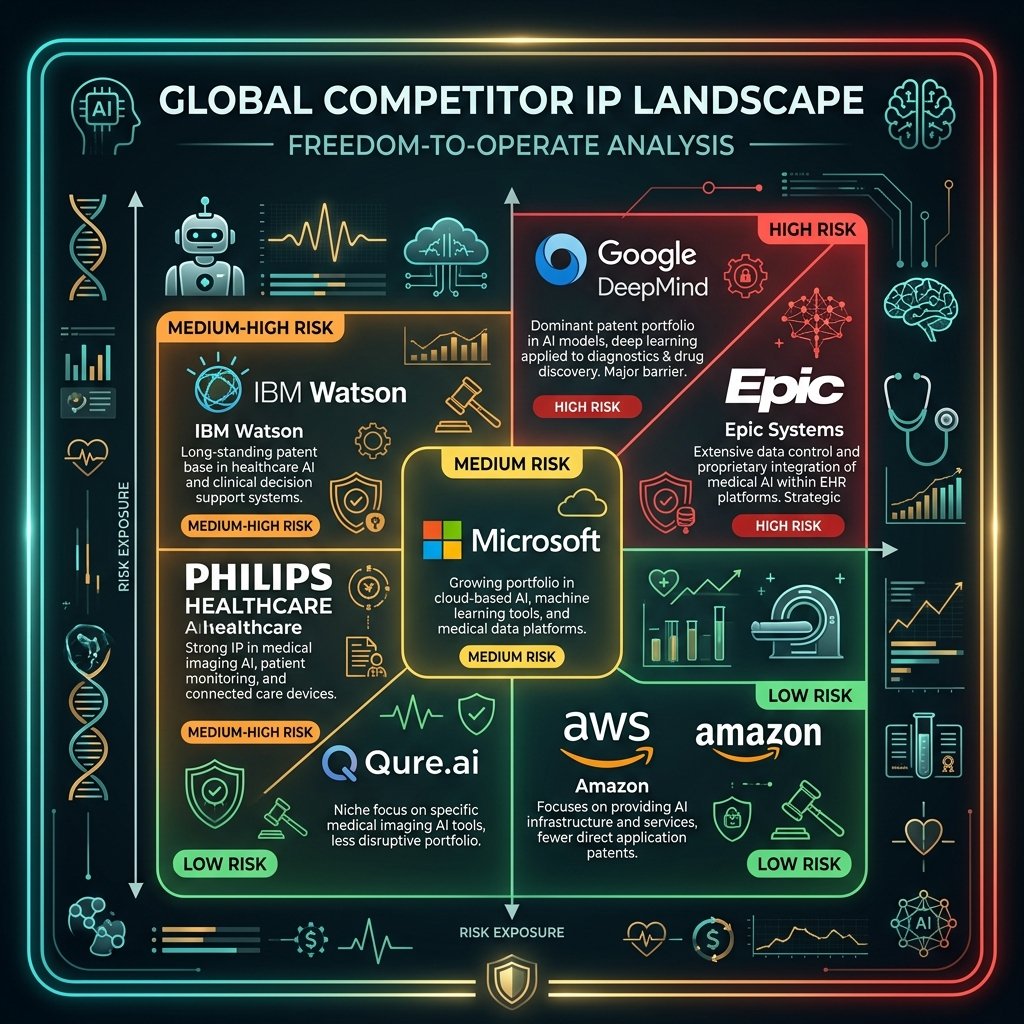
Understanding competitor patent portfolios is essential for freedom-to-operate analysis and positioning MedAI's claims.
| Company | Country | Patent Volume | Closest Technology | IP Risk |
|---|---|---|---|---|
| Google (DeepMind) | USA | 500+ AI/healthcare | EHR prediction, sepsis, NLP | HIGH |
| Epic Systems (Cosmos/CoMET) | USA | Growing (Cosmos AI) | Foundation models on 300M records | HIGH |
| IBM Watson (Merative) | USA | 300+ CDS patents | Clinical decision support, oncology | MEDIUM-HIGH |
| Philips Healthcare | Netherlands | High (clinical monitoring) | ICU monitoring, sepsis scoring | MEDIUM-HIGH |
| Microsoft (Nuance) | USA | 200+ healthcare AI | Clinical NLP, EHR integration | MEDIUM |
| AWS (HealthLake) | USA | Medium (no patent on TabTransformer) | TabTransformer โ public domain | LOW |
| Qure.ai / Indian companies | India | Low-medium | AI radiology (different domain) | LOW |
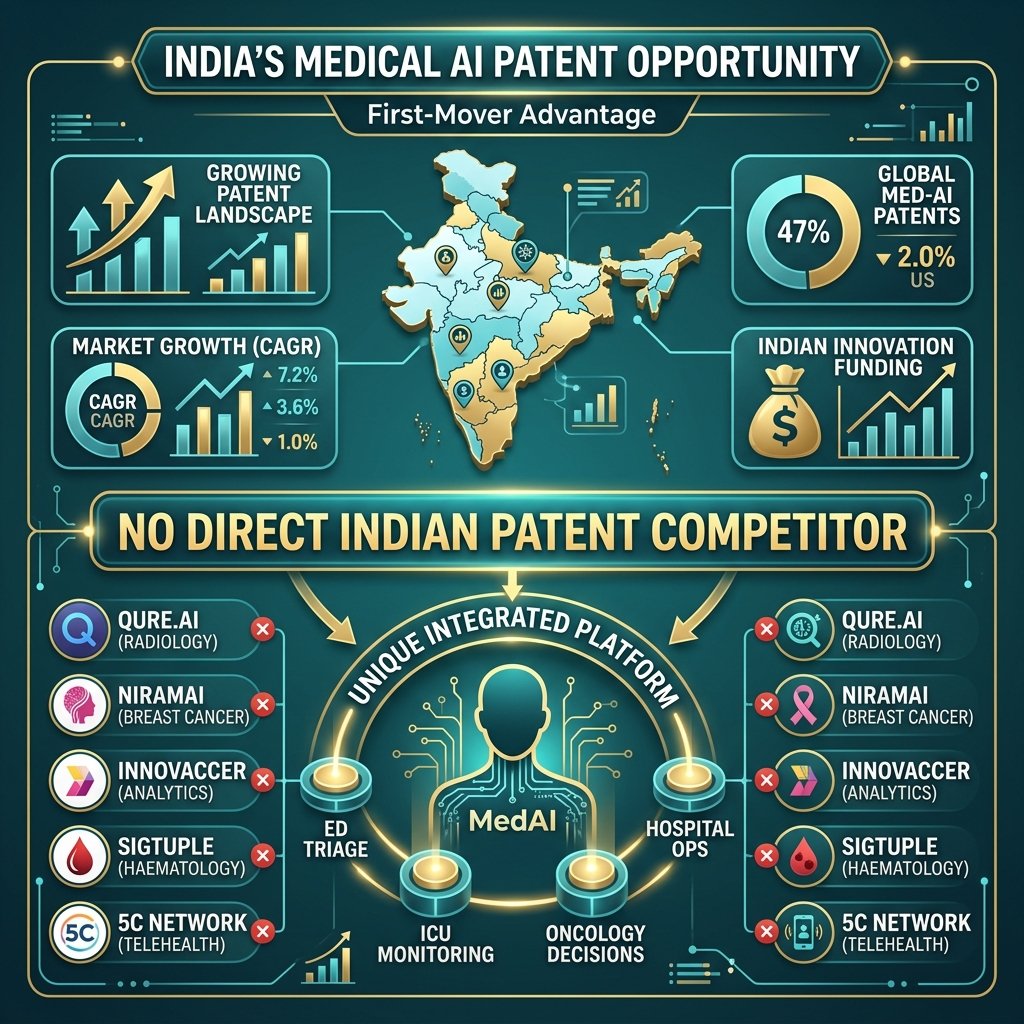
The integrated clinical AI CDSS space targeting ED triage + ICU + Oncology + Hospital Operations in a single Indian-market platform has NO direct Indian patent competitor. This is a significant first-mover filing opportunity for the MSR Group ร Lattice Consulting joint venture.
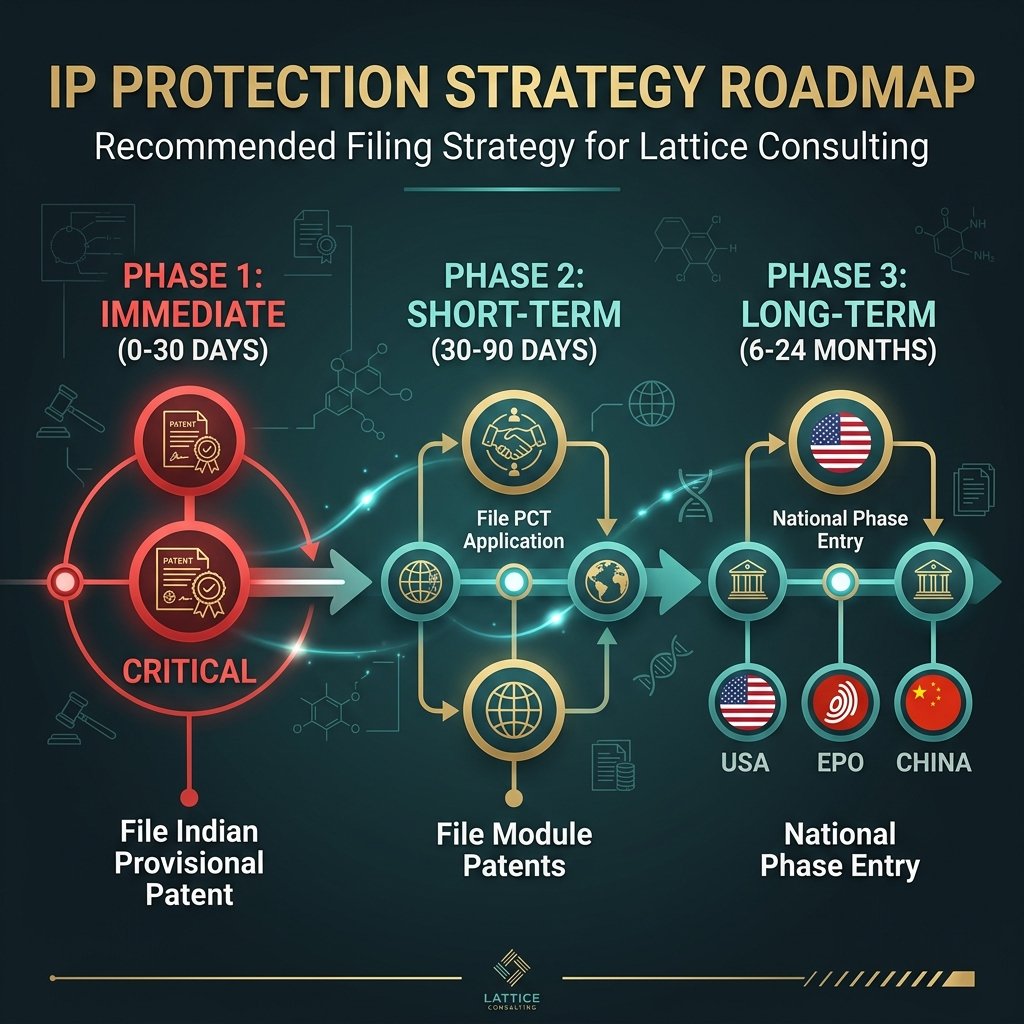
Phase-wise filing strategy for MSR Group ร Lattice Consulting to secure joint global patent rights for MedAI technology.
Under the Indian Patents Act, if MedAI technology has been disclosed (including pitch decks, investor documents, or presentations), the MSR Group ร Lattice Consulting joint venture has a 12-month window from the first disclosure date to file a patent application. Both co-applicants must file a provisional application IMMEDIATELY to preserve the priority date.
Step-by-step strategy to transition from validation to mass government procurement.
Before physical deployment, laying the regulatory groundwork.
Private deployments within the MSR Hospital network and 5 target rural districts (Ramanagara, Kolar, Tumkur, Mandya, Chikkaballapur).
Shifting focus to localized manufacturing and government scheme integrations.
Transitioning to a highly localized, export-ready manufacturing base.