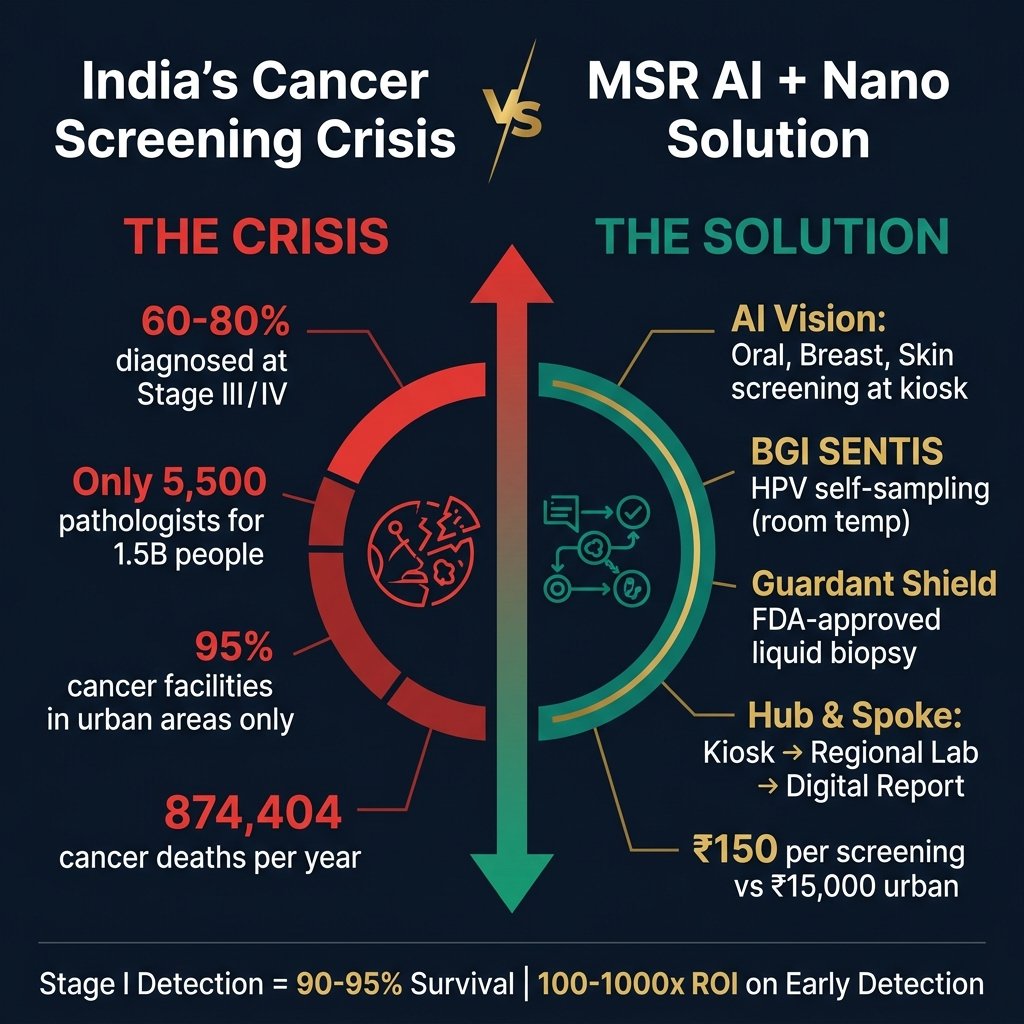
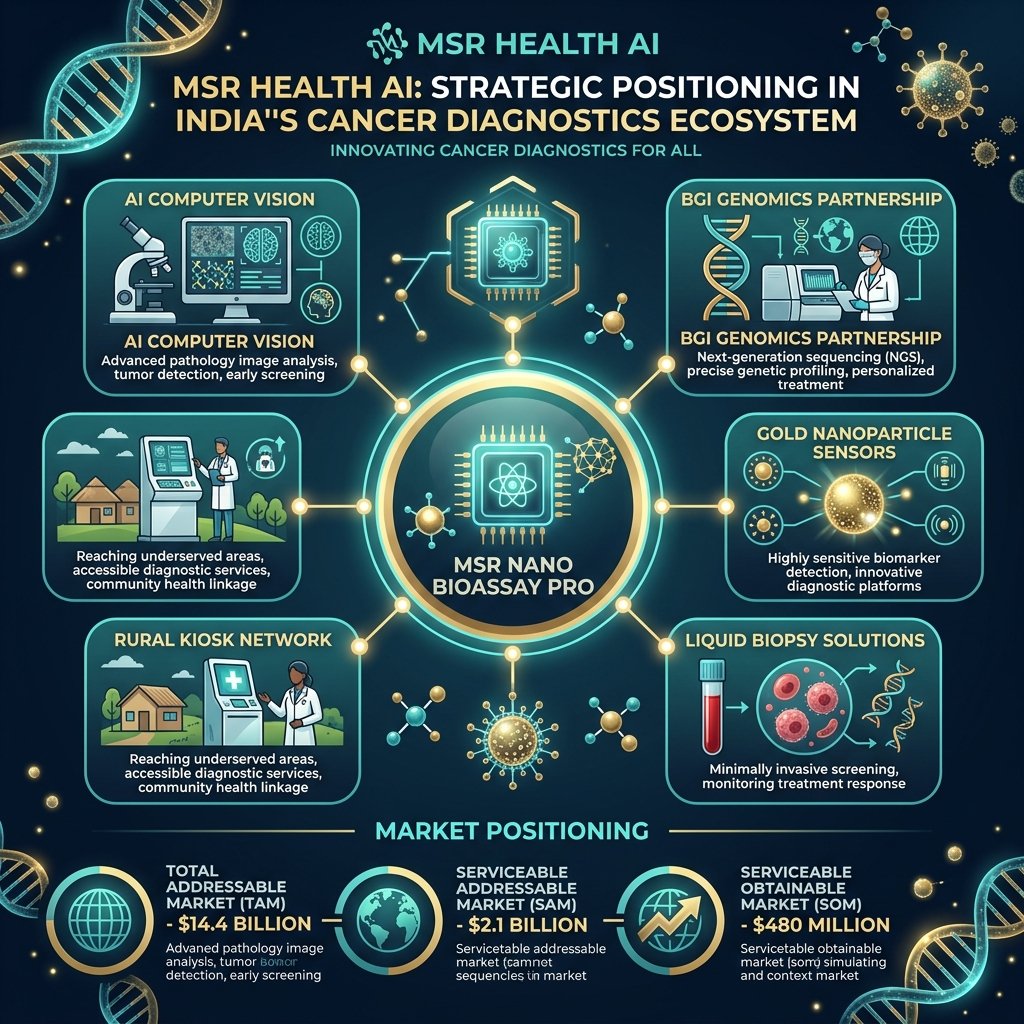
Combining AI computer vision, nano-level biosensors, and BGI genomic sequencing to detect cancer early โ at the MSR Health Kioskโข doorstep. From 1.56M+ new cases annually to a future of early interception.
Deep-dive documentaries exploring how MSR Health AI, nano-level biosensors, and Google AI are converging to fight India's cancer epidemic โ from rural kiosks to regional genomics hubs.
1 in 9 Indians will develop cancer. Over 60% are diagnosed at Stage III/IV due to lack of screening infrastructure.
Traditional methods miss early-stage cancers. AI vision and nano diagnostics catch what human eyes cannot.
Mammography (urban only), clinical exam, MRI (Tier 1)
โ Needs radiologist, radiation, expensiveThermalytix IR imaging + AI risk scoring (radiation-free)
โ ASHA-operated, 0.18% detection, PPV 81.81%Pap smear, VIA (50-79% sensitivity), colposcopy
โ Needs cytologist, 2-3 day TATAI-VIA (89-94%) + BGI HPV self-sampling (98.82%)
โ Self-collect, room temp, no speculumVisual inspection, toluidine blue, biopsy
โ Misses sub-mucosal lesionsCNN on oral photos + autofluorescence LED
โ >90% sensitivity, smartphone deployableChest X-ray, LDCT (urban only), sputum cytology
โ Misses nodules <1cm, late detectionAI LDCT (92% sens.) + ctDNA liquid biopsy
โ DELFI model: 94% sens., 80% spec.FOBT, colonoscopy (invasive, specialist needed)
โ Low awareness, bowel prep requiredCOLOTECT 3.0 stool DNA (96.08% sens.)
โ Home collection, no endoscopy neededDermatoscopy (specialist), biopsy
โ Dermatologist shortage in rural IndiaYOLO-v8 + EfficientNet dermoscopy AI
โ 84-92% accuracy, edge-deployableFrom CNNs to Foundation Models โ the technology powering next-generation cancer detection at the MSR Health Kioskโข.
CHIEF model trained on 60,000 WSIs โ AUROC 0.9397 across 11 cancer types. 10-14% better than prior models.
Multi-head attention captures spatial relationships across whole slide images. Outperforms CNNs on large histopathology datasets.
Reduces radiologist reads by 88%. Non-inferior to 2-reader workflow for mammography screening.
Stages ovarian cancer with 97% accuracy vs. 88% by radiologists. Skin lesion classification on par with dermatologists.
Integrates imaging + genomic + clinical + liquid biopsy data. CancerSEEK detects multiple types from blood.
AIIMS + CDAC indigenous AI platform. Deep learning for radiological + histopathological analysis. Breast & ovarian focus.
Five nanotechnologies from leading global companies โ integrated into MSR's cancer detection infrastructure through a Hub-and-Spoke Lab Network model.
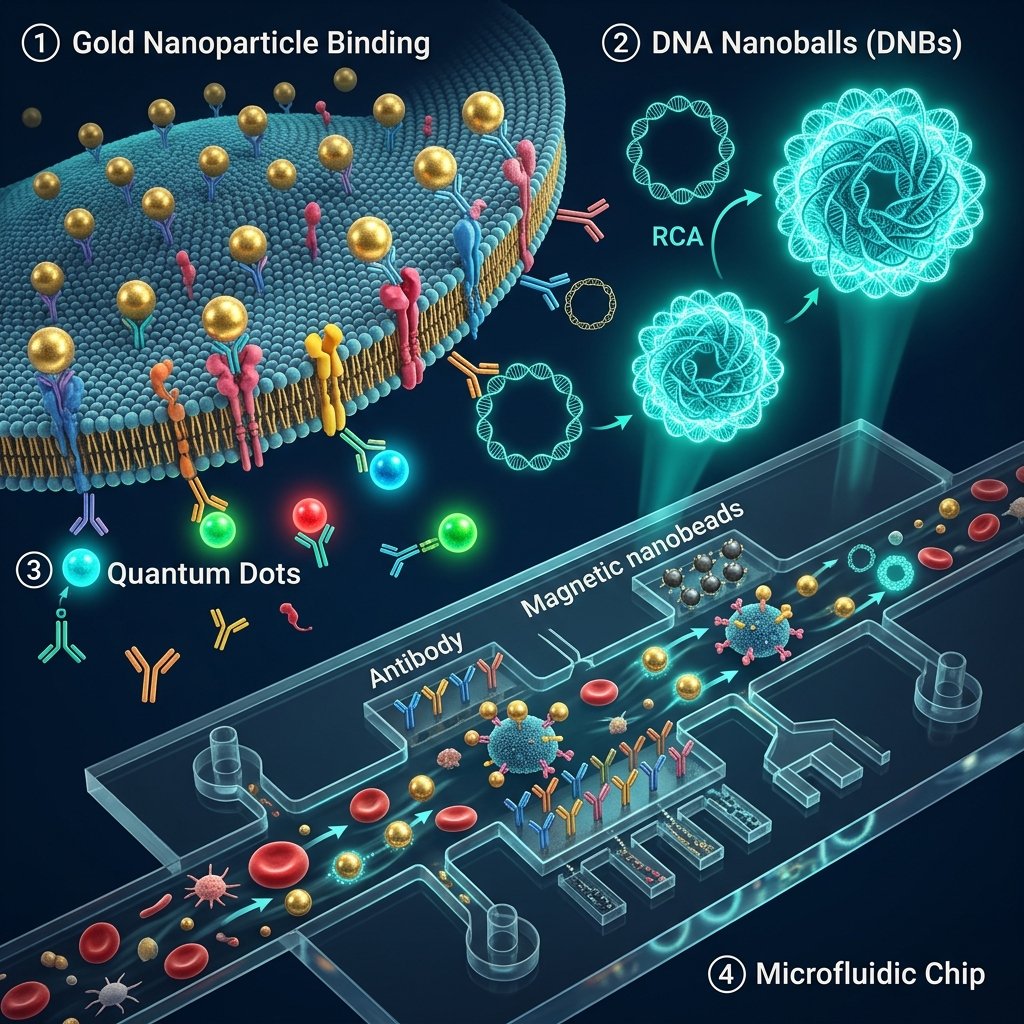
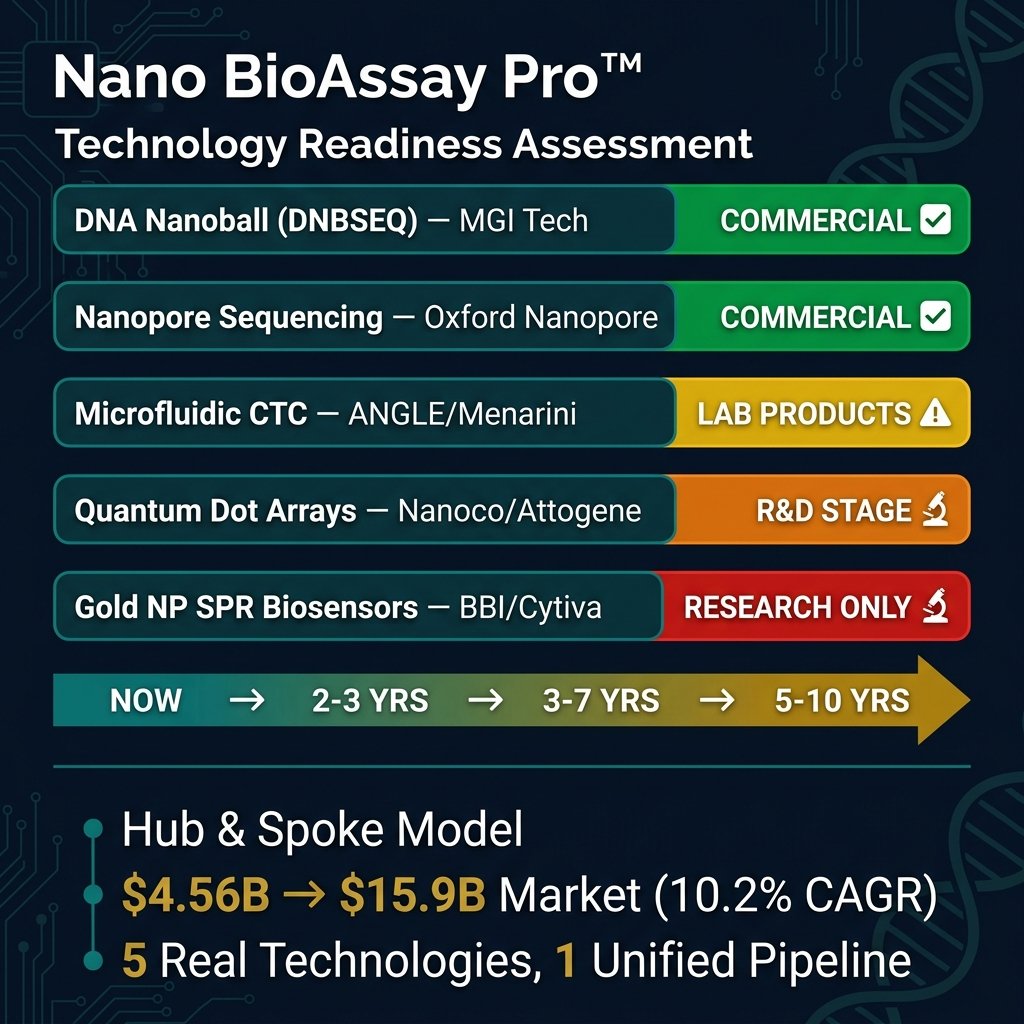
The Nano BioAssay Proโข is MSR Health AI's proposed integration framework โ combining five real, cutting-edge nanotechnologies from companies like MGI Tech, Oxford Nanopore, ANGLE plc, and Menarini into a unified cancer detection pipeline. Each technology is at a different stage of commercial readiness.
These nanotechnologies cannot be deployed inside a kiosk. They require lab-grade infrastructure, trained technicians, cold-chain reagents, and regulatory certification. MSR's model is: kiosk collects samples โ regional lab processes โ digital reports returned via MSR Connectโข.
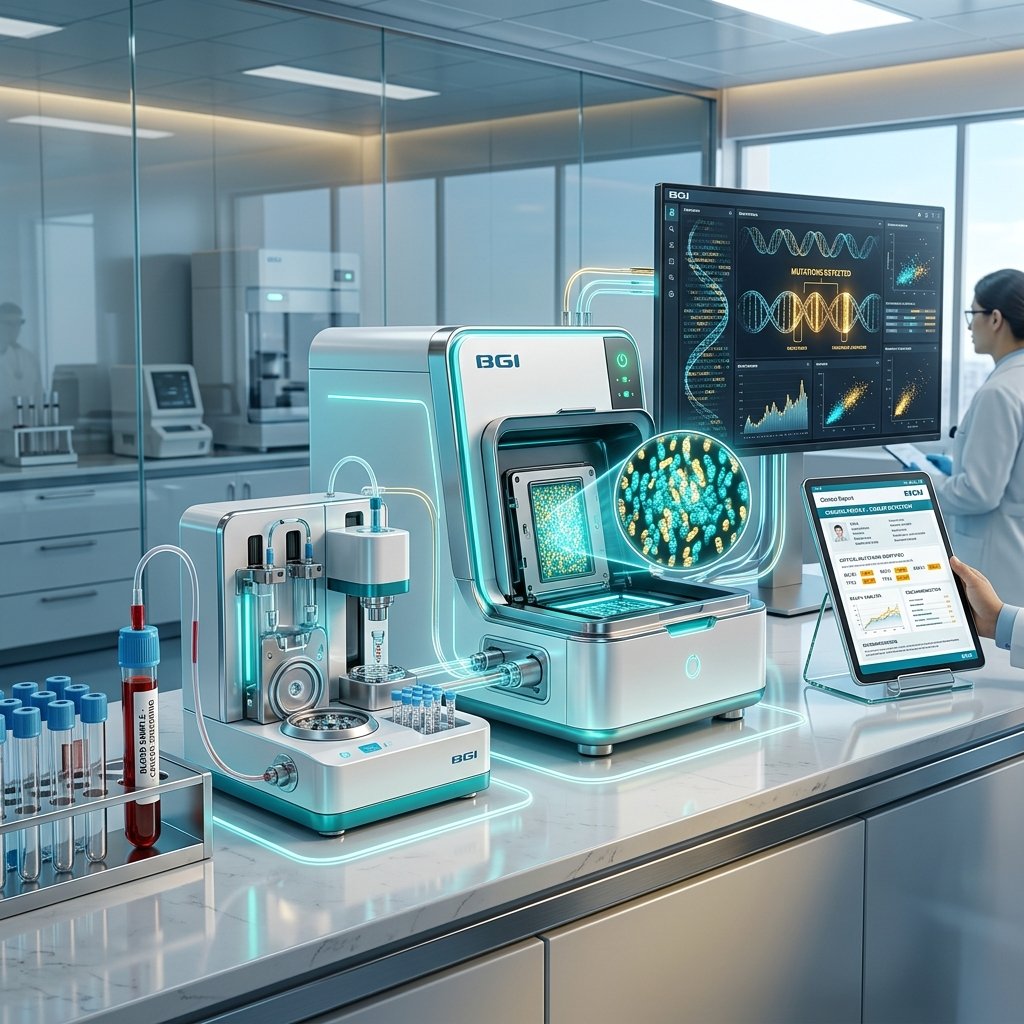
Single-strand DNA circularization + rolling circle replication creates nanoballs on patterned arrays. Used clinically for cancer genomics, HPV screening (with Predica Diagnostics, March 2026), and liquid biopsy ctDNA panels.
20nm gold spheres functionalized with antibodies for ctDNA biomarker detection via surface plasmon resonance. Femtomolar sensitivity demonstrated in academic studies โ no commercial clinical product exists yet. SPR instruments cost $50Kโ$200K.
Semiconductor nanocrystals (2-10nm) emit distinct wavelengths for multiplexed CEA, AFP, PSA, CA-125 detection. Scientifically validated but no FDA/CE-approved multiplexed cancer screening product exists. Requires fluorescence reader hardware.
Blood processed through microfluidic channels to capture circulating tumor cells. CellSearch (Menarini) is FDA-cleared for breast, colorectal, prostate CTC. Parsortix (ANGLE) is CE-marked. Both are lab-only instruments, processing takes 2โ3 hours, not 30 minutes.
Single-molecule sequencing via protein nanopores. Native methylation detection without bisulfite conversion. MinION is portable (~$1,000), used clinically for brain tumor classification during surgery (2025). GridION Dx has CE-IVD status. Needs DNA extraction + library prep training.
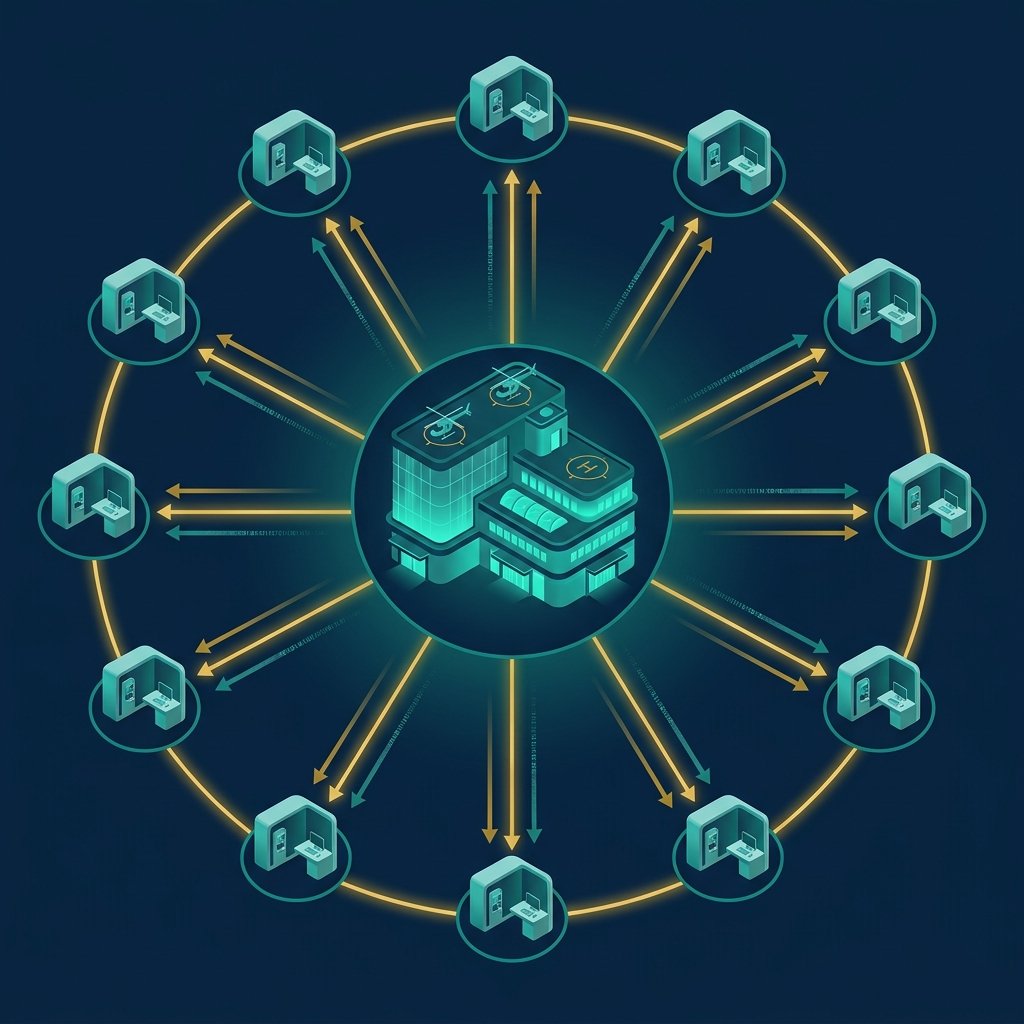
Advanced cancer detection requires laboratory infrastructure. The MSR model uses Regional Diagnostic Hubs connected to village kiosks via a digital sample logistics network.
DNBSEQ requires -20ยฐC reagent storage, controlled lab environments (18-25ยฐC), and humidity management. Kiosks lack HVAC-grade climate control in rural India (ambient 35-45ยฐC).
DNA extraction, library preparation, flow cell loading, and bioinformatics require MSc-level molecular biology training. ASHA health workers cannot operate genomic sequencers.
DNBSEQ-T7+: ~โน2-3 Cr. CellSearch: ~โน50L. MinION: ~โน85K but consumables ~โน40K/run. SPR instruments: โน40L-1.5Cr. Not viable per-kiosk at โน8-10L kiosk cost.
NABL accreditation (ISO 15189), CDSCO IVD registration, biosafety level 2 containment, and biomedical waste management are mandatory. Kiosks cannot meet BSL-2 requirements.
NGS: 24-48 hrs library prep + 12-36 hrs sequencing + 4-8 hrs bioinformatics. CTC analysis: 2-3 hrs. These workflows don't fit kiosk "walk-in, walk-out" model.
Sequencers need uninterrupted power (UPS + backup generator). DNBSEQ-T7+ draws ~2.5kW. Rural kiosks typically have solar + battery systems (~500W capacity).
1 Regional Diagnostic Hub serves 10-15 MSR Health Kiosks within a 100km radius. Samples travel to the lab; digital reports return to the kiosk patient.
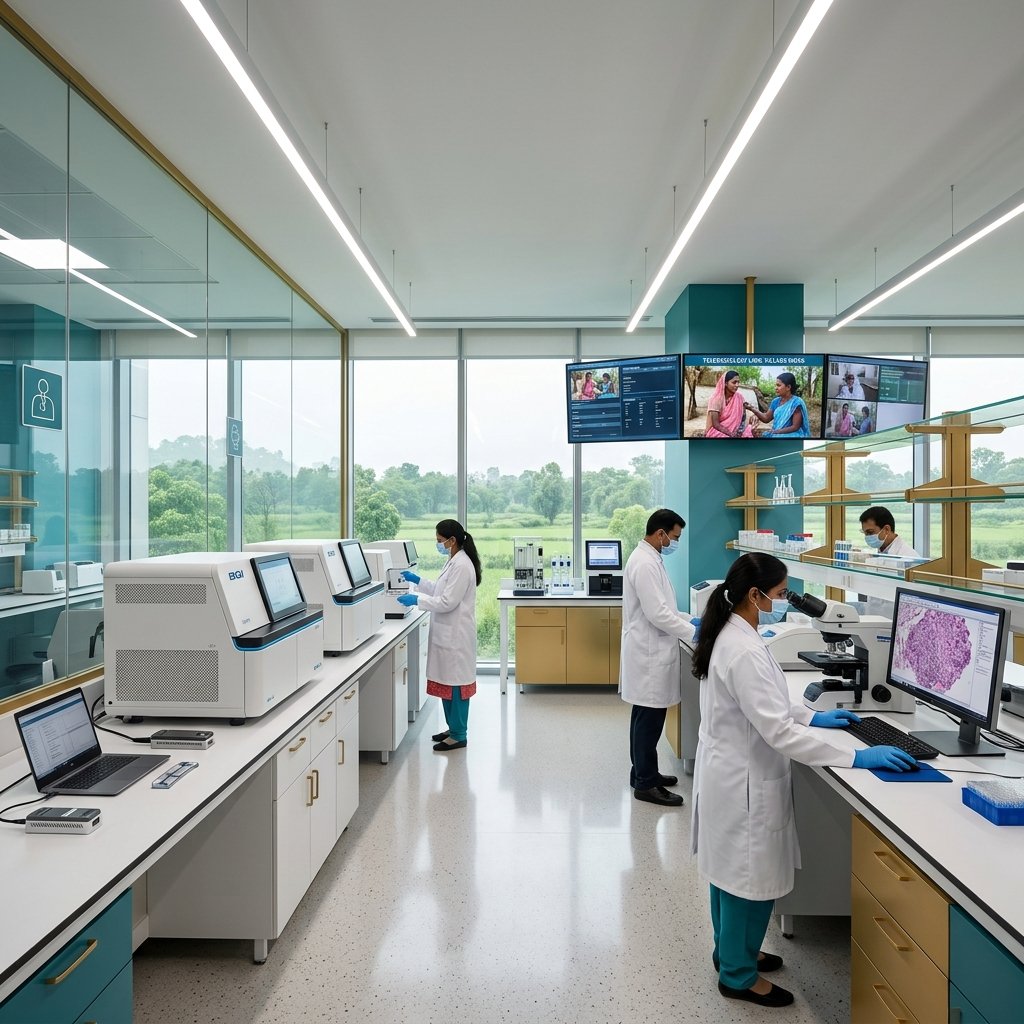
Each hub is a NABL-accredited, BSL-2 compliant laboratory at a district hospital or private diagnostic partner facility. Equipped with MGI DNBSEQ sequencer, Oxford Nanopore MinION, digital pathology scanner, and AI-powered bioinformatics server.
Each regional hub houses 4 stations: NGS Station (MGI DNBSEQ), Rapid Sequencing (Oxford Nanopore MinION), Digital Pathology (AI slide scanning), and Telemedicine Command Center (MSR Connectโข for kiosk coordination and result delivery).
Blood draw, HPV FTA card, stool kit. Barcode linked to patient EMR.
Temperature-controlled sample transport to regional hub (daily route, <4 hrs).
DNA extraction โ library prep โ NGS/nanopore sequencing โ AI bioinformatics.
AI-generated report โ oncologist review โ MSR Connectโข โ patient notification at kiosk.
CE-marked, ISO-certified genomic panels integrated into the MSR kiosk workflow โ from HPV screening to 816-gene comprehensive profiling.
BGI Genomics provides the Layer 3 genomic confirmation for patients flagged by the MSR kiosk AI screening. From self-collected HPV samples to comprehensive 816-gene ctDNA panels โ all coordinated through the MSR Connectโข telemedicine hub.
Self-sampling on FTA card. 14 high-risk HPV types. Room-temp shipping.
Multi-target fecal DNA + FIT. Home stool collection, no endoscopy.
Advanced NSCLC guidance. 50 genes, SNVs/InDels/CNVs/fusions. 130+ drugs mapped.
Comprehensive profiling: tissue + ctDNA. TMB, MSI, 360+ drug interpretations.
From non-invasive AI vision screening to genomic confirmation โ a seamless patient journey at the MSR Health Kioskโข.
Non-invasive, no lab, no specialist. On-device AI inference.
For AI-flagged patients. Point-of-care testing at kiosk.
Hub lab integration via MSR Connectโข telemedicine.
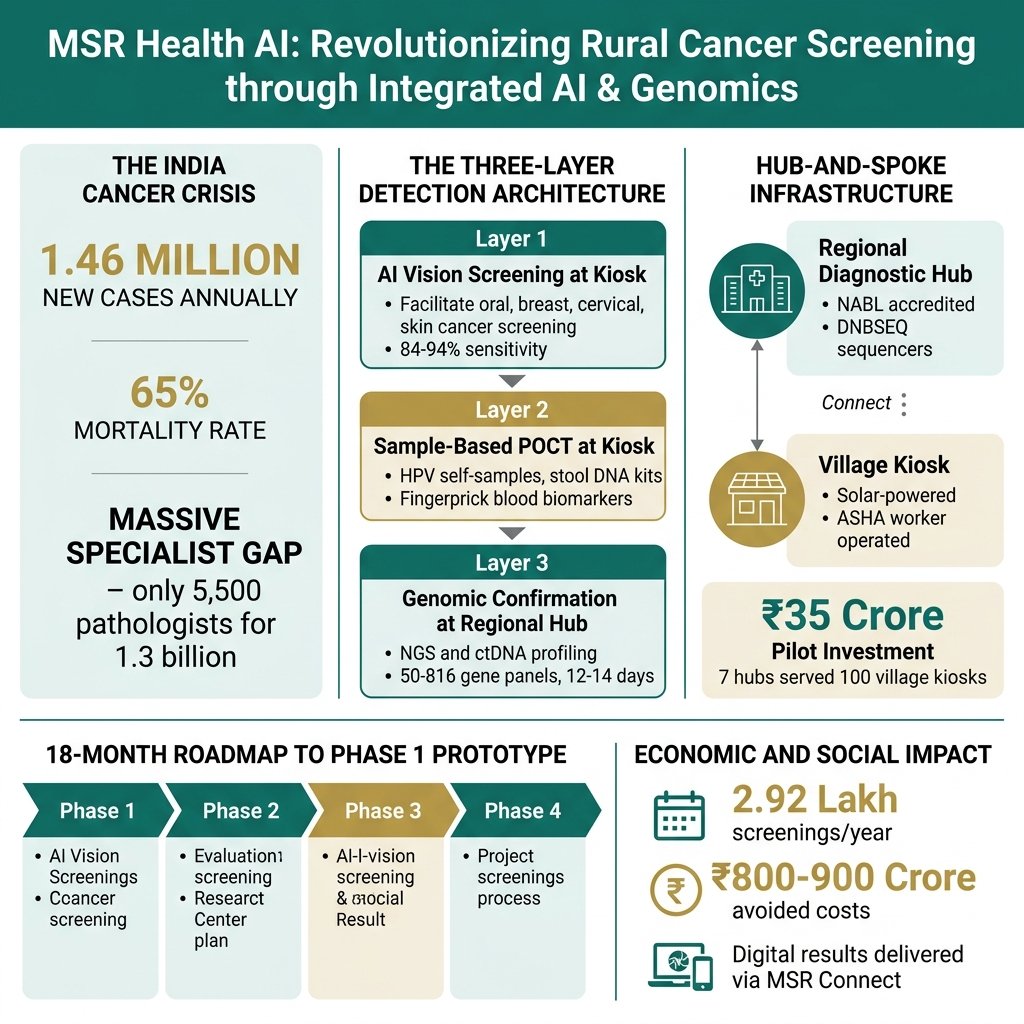
From India's cancer crisis to the 3-layer kiosk architecture, hub-and-spoke infrastructure, 18-month roadmap, and projected impact โ the full MSR Health AI cancer strategy in one view.
Click to enlarge โข India Cancer Crisis โ 3-Layer Detection โ Hub-and-Spoke Labs โ 18-Month Roadmap โ Economic Impact
Validated AUROC scores and sensitivity metrics across cancer types โ demonstrating clinical-grade AI performance.
11 cancer types, 24 hospitals
vs. 88% by radiologists
LDCT screening automation
Stool DNA sensitivity
BGI SENTIS sensitivity
MSI prediction AUROC
SENTIS panel suite, COLOTECT, HPV test. Lab services contract + sample logistics.
Thermalytix breast cancer AI. Radiation-free IR thermography. White-label for kiosk.
iOncology.ai platform. Government co-branding + data exchange for Indian cancer AI.
MedGemma, AMIE, Mammo AI models. India-specific fine-tuning on kiosk data.
Nano BioAssay Proโข is our proprietary integration architecture combining 5 real, independently verified nanotechnologies from companies like MGI Tech, Oxford Nanopore, ANGLE plc, and Menarini into a unified cancer detection pipeline. Each technology is at a different stage of commercial readiness โ this report provides full transparency.
Each of the 5 underlying technologies has been independently fact-checked against real companies, FDA/CE regulatory status, and commercial product availability. 2 are fully commercialized (MGI DNBSEQ, Oxford Nanopore), 1 has FDA-cleared lab products (Menarini CellSearch), and 2 remain in academic R&D (Quantum Dots, Gold SPR).
MSR's deployment model accounts for this reality: kiosks collect samples โ regional NABL-accredited labs process โ digital reports returned via MSR Connectโข. No nano technology sits inside the kiosk itself โ this is the honest, scalable architecture.
While India ranks 3rd globally in cancer incidence, an estimated 60-80% of patients are diagnosed at Stage III/IV when treatment is expensive, invasive, and often futile. The primary reason: 95% of specialized cancer care facilities are concentrated in urban areas, leaving rural India โ 65% of the population โ virtually unscreened.
With only 5,500 pathologists serving 1.5 billion people (vs. 18,000+ in the US serving 330M), India faces an insurmountable specialist shortage. AI and nano diagnostics are the only scalable solution to bridge this gap.
AI Vision Screening (oral, breast thermography, skin) โ proven & deployable. BGI SENTIS HPV self-sampling โ FTA card, room temp. BGI COLOTECT stool DNA โ home collection. Guardant Health Shield โ FDA-approved blood CRC screening (July 2024). Rapid biomarker tests (CEA, PSA, AFP) โ lateral flow. Stage I detection yields 90-95% survival โ a 100-1,000ร ROI vs late-stage treatment.
| Year | Total Market | AI + Nano Segment | New Cases (Proj.) | Screened Early (Target) | MSR AI Role |
|---|---|---|---|---|---|
| 2025 | $4.56B | $320M | 1.56M | ~20% | Pilot โ 100 kiosks, Karnataka |
| 2026 | $5.03B | $420M | 1.62M | ~25% | 500 kiosks + BGI lab network |
| 2027 | $5.54B | $550M | 1.68M | ~30% | 2,000 kiosks + 5 state expansion |
| 2028 | $6.10B | $720M | 1.74M | ~35% | Nano BioAssay Proโข FDA filing |
| 2029 | $6.72B | $940M | 1.80M | ~40% | 5,000 kiosks + liquid biopsy |
| 2030 | $8.12B | $1.23B | 1.87M | ~45% | 10,000+ kiosks, all-India |
| 2031 | $8.95B | $1.60B | 1.93M | ~50% | National Cancer Grid integration |
| 2032 | $10.5B | $2.08B | 1.99M | ~55% | 20,000 kiosks + QD multiplexing |
| 2033 | $11.8B | $2.71B | 2.04M | ~60% | SE Asia expansion begins |
| 2034 | $14.4B | $3.52B | 2.08M | ~65% | 50,000 kiosks across 5 nations |
| 2035 | $15.9B | $4.58B | 2.12M | ~70% | 100,000 kiosks โ global leader |
Sources: TechSci Research, IMARC Group, Grand View Research, Virtue Market Research, NCRP India (2024-25). AI Dx CAGR: Fortune Business Insights. Projections calculated using compound growth models.
MSR Health AI occupies a unique niche โ the only platform integrating AI computer vision, nano biosensors, and rural kiosk delivery into a single cancer screening pipeline. No competitor combines all three.
Total India cancer diagnostics market (2034) โ imaging, pathology, molecular, genomics, AI
AI-powered + nano-biosensor + point-of-care cancer screening segment โ rural + semi-urban India
MSR's realistic capture with 50,000 kiosks across Karnataka, Telangana, Tamil Nadu + BGI lab network by 2034
Only platform integrating 5 nanotechnologies (DNBSEQ โ MGI Tech, MinION โ Oxford Nanopore, CellSearch โ Menarini, QD Arrays, Gold SPR) + AI vision + BGI genomics into a phased screening pipeline. Patent filing: April 2026.
India's largest AI kiosk network reaching 65% rural population. Hub-and-spoke lab model means samples collected at doorstep, processed at regional labs, reports via MSR Connectโข โ all within 48 hours.
Google AI Health partnership for India-specific cancer models. Every screening generates training data โ creating the world's largest rural cancer dataset. Next-gen models get better with scale โ an unassailable data flywheel.
โน150/screening vs. โน5,000-15,000 at urban centres โ 30-100ร cost reduction. Revenue stacks: hardware (61% margin) + SaaS (80% margin) + lab referral commission (15%) + government subsidies.
Impact projections based on ICMR cancer registry data, WHO early detection survival models, and MSR Health AI's deployment roadmap. Stage I detection saves โน3-12L per patient vs Stage III/IV treatment costs.
Join MSR Health AI ร BGI Genomics to bring nano-level cancer screening to every village in Karnataka and beyond.