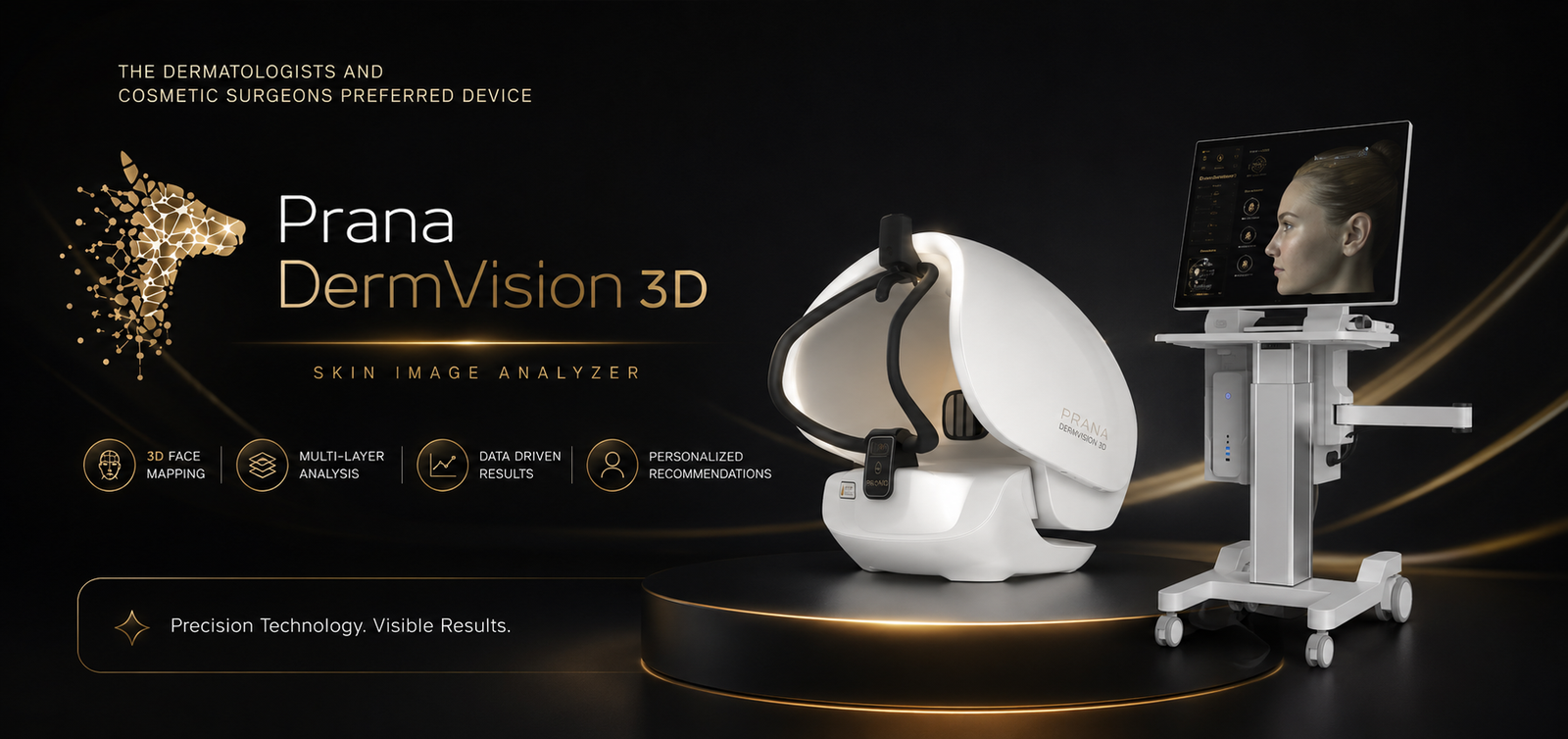
India's 1st AI-Powered 3D Skin Analyzer

Precision Dermatology with Prana DermVision 3D

12-channel spectral imaging. 38-dimension AI analysis. 3D facial mapping at 0.15mm precision. Purpose-built for Indian skin types (Fitzpatrick III–VI) — closing the dark skin AI gap that every global device ignores.
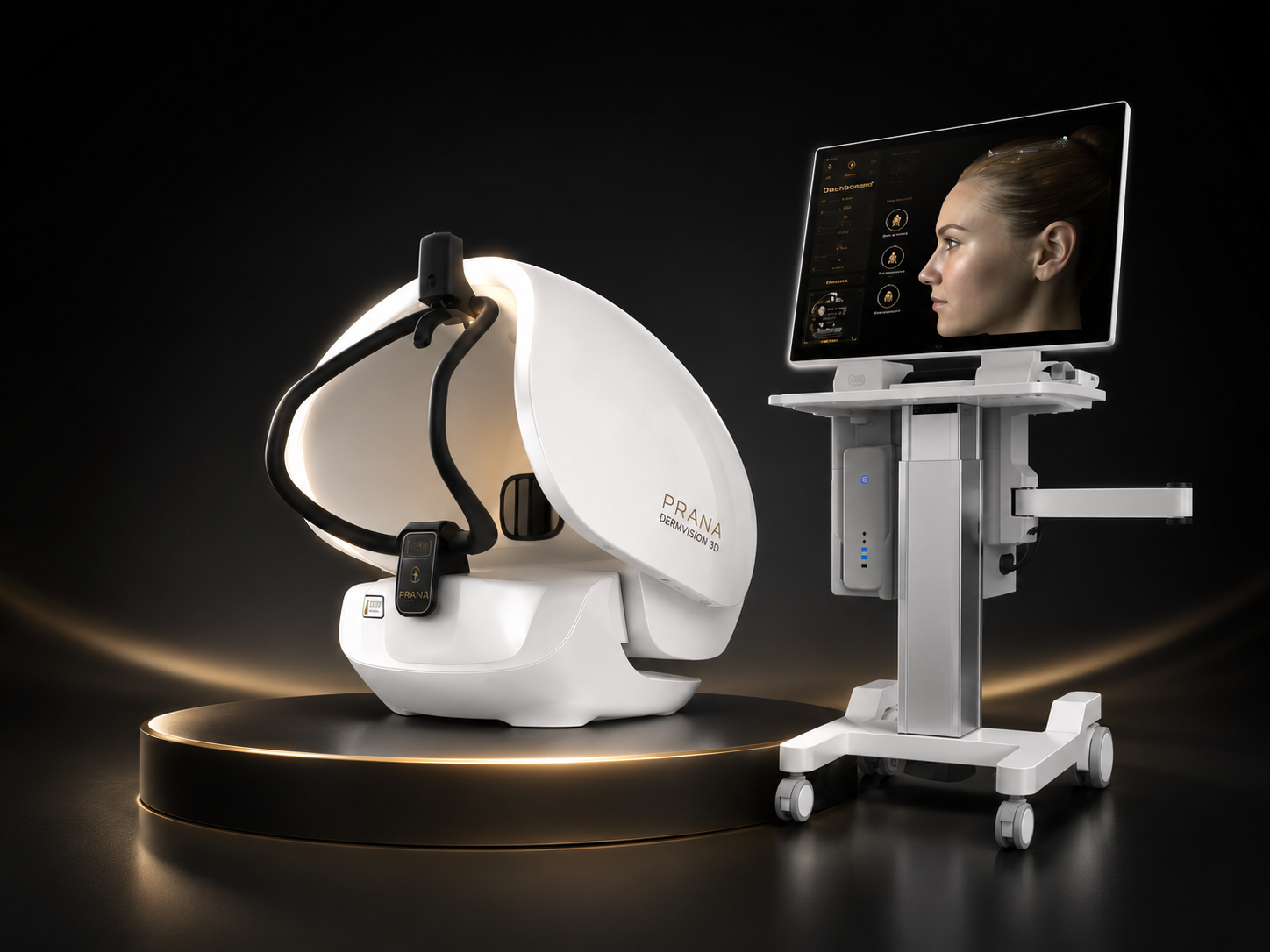
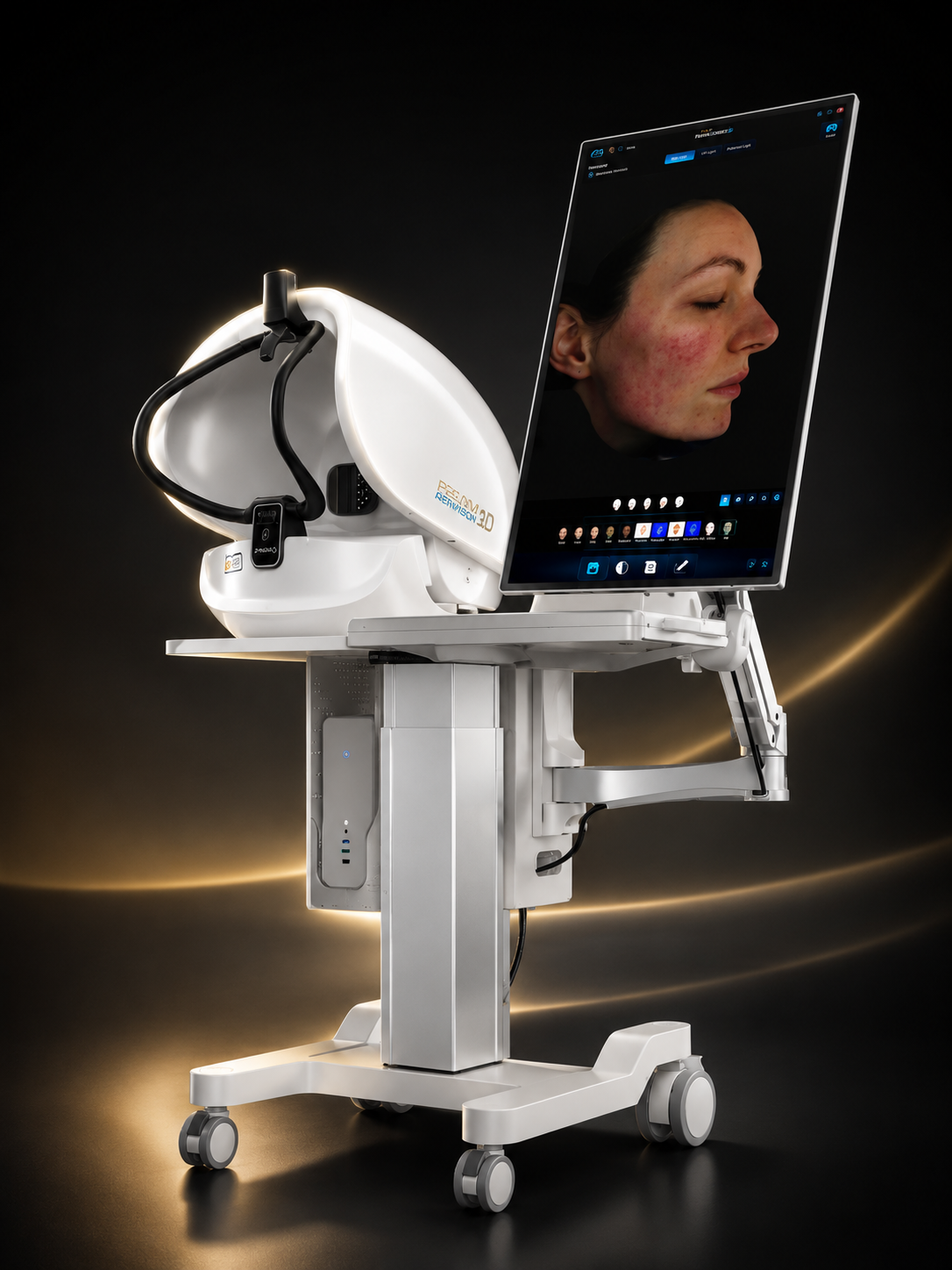
Prana DermVision 3D Skin Analyzer
12Spectral Channels
38Skin Dimensions
0.15mm3D Precision
8 secFull-Face Scan
42MPFull-Face Resolution
FST III–VIIndia-Calibrated
4India-Exclusive Modules
DPDPAct 2023 Compliant
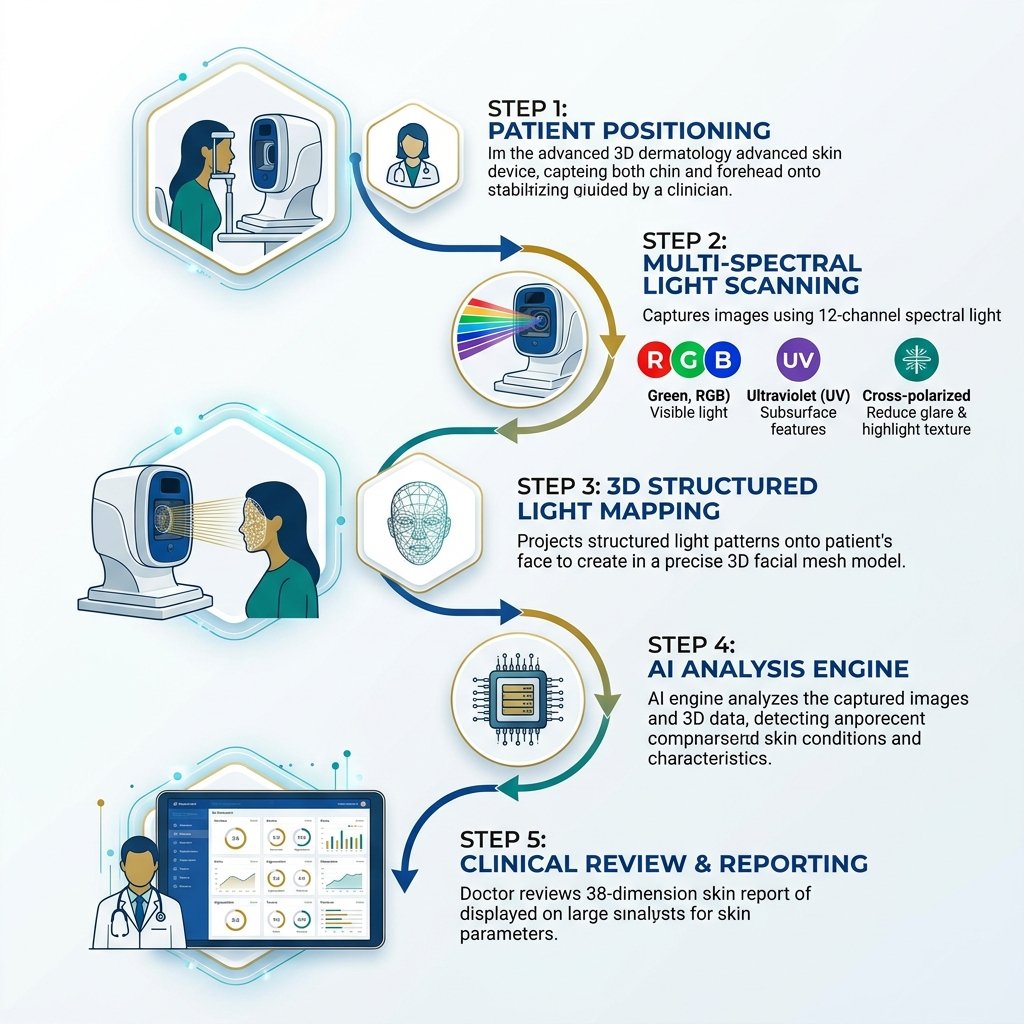
Step-by-Step Process

How DermVision 3D Works

From patient seating to AI-generated clinical report — the entire process takes under 60 seconds, delivering 38 quantified skin dimensions.

Patient Positioning

Patient places face in the ergonomic chin rest with adjustable forehead stabiliser. The technician initiates the scan from the touchscreen console.

Adjustable Chin RestUV-C Self-Disinfect

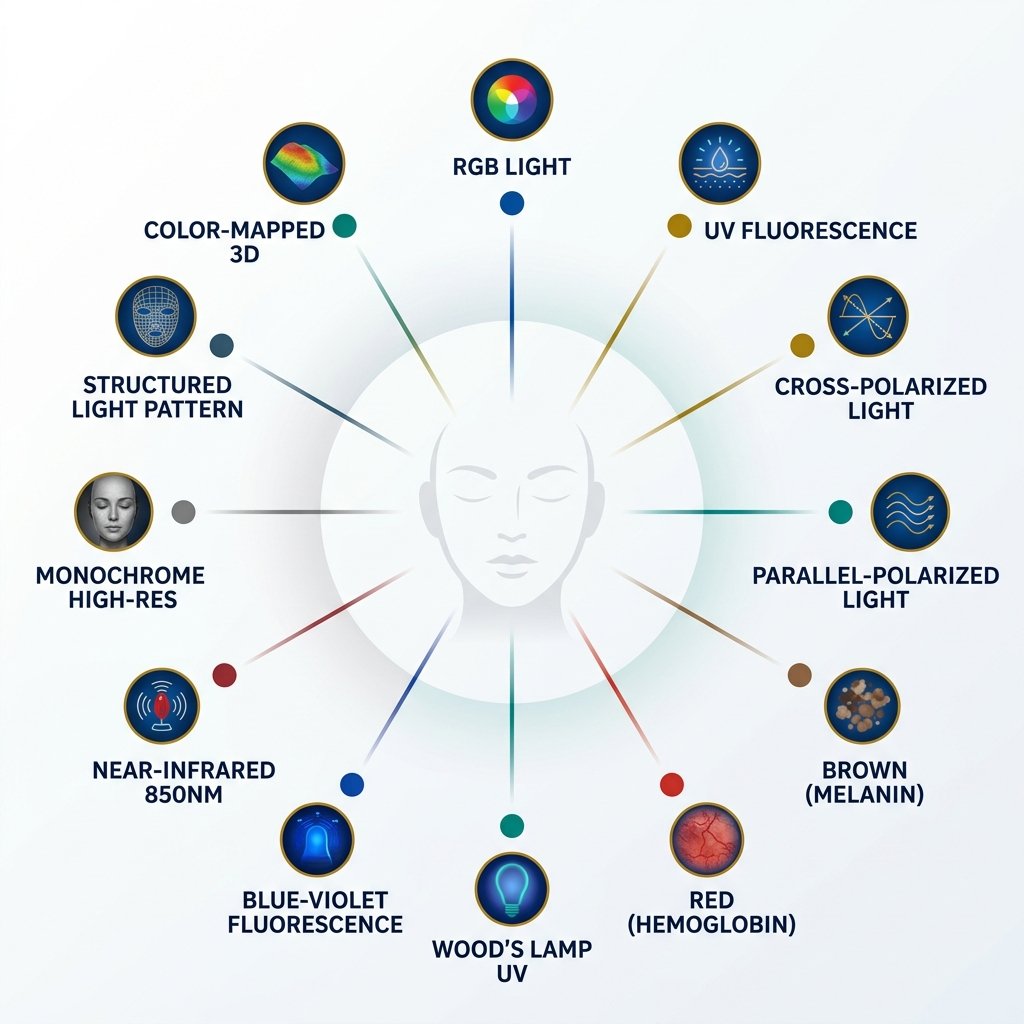
12-Channel Spectral Imaging

12 spectral channels in 8 seconds — RGB, UV, Cross-Polarised, Parallel-Polarised, Brown, Red, Wood's Lamp, NIR 850nm. Each reveals a different skin layer.

RGBUV 365nmCPLNIR 850nm

3D Structured Light Mapping

Binocular grating + ToF sensor fusion creates a precise 3D mesh with ~250,000 vertices at 0.15mm resolution, colour-mapped for photorealistic rendering.

650nm LaserToF DepthKalman Fusion

AI Analysis Engine

Deep learning analyses 2D spectral images and 3D mesh to produce 38 skin dimensions. India-specific modules detect melasma, periorbital darkening, vitiligo and PIH.

PyTorchONNXResNet-50

Clinical Report & Treatment Advisory

One-click PDF report with 3D images, AI scores, heatmaps, and IADVL treatment recommendations. Delivered to ABHA health locker + WhatsApp in <15 seconds.

ABHAWhatsApp APIAadhaar eSign
DermVision 3D Scan Workflow
12 Spectral Imaging Channels
⚠️ The Critical Problem

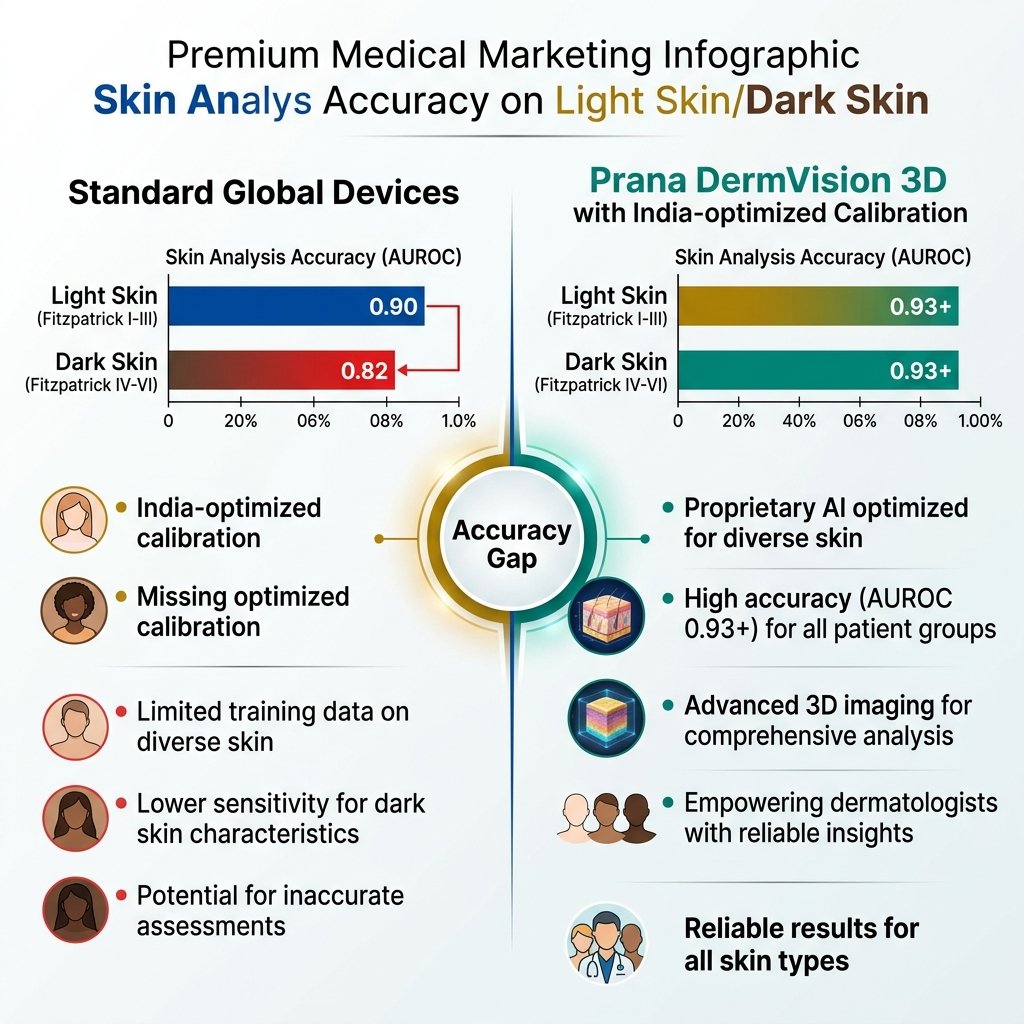
The Dark Skin AI Gap

Every global skin analyzer is calibrated for Caucasian and East Asian skin. Indian skin (FST III–VI) shows a documented AUROC drop from 0.89 to 0.82 on existing devices. Prana fixes this at the hardware, optics, and AI training level.

★ Featured Research Prana DermVision 3D — The Optical Bias Problem

🎬 The Optical Bias: Why "More Data" Won't Fix Medical AI

A deep-dive documentary exploring why the standard industry response of "just collect more diverse training data" fundamentally fails to address the optical physics problem in dermatology AI. The video explains how melanin absorbs and scatters light differently across Fitzpatrick III–VI skin types, creating a hardware-level bias that no amount of software post-processing can overcome — and how Prana DermVision 3D solves this with FST-adaptive exposure, NIR 850nm imaging, and India-specific spectral calibration.

Optical Physics AI Bias DermVision 3D Melanin-Adaptive FST III–VI
Dark Skin AI Accuracy Gap

Why Global Devices Fail on Indian Skin

  • Melanin Saturation: Higher melanin in FST IV–VI absorbs more UV and visible light, reducing signal-to-noise ratio in standard imaging
  • Training Data Bias: Global AI models trained on TCGA/Western datasets show measurable performance drops on Indian tissue samples
  • No India-Specific Conditions: Melasma depth, periorbital darkening types, vitiligo VASI — none classified in any global analyzer
  • Fixed Calibration: Single exposure settings optimised for light skin under-expose dark skin, losing sub-surface detail

How Prana Solves This

FST-adaptive exposure per channel • India-specific AI training data (8,000+ melasma cases from AIIMS Delhi + MSR) • NIR 850nm channel for vascular vs pigmentary differentiation on dark skin • Hardware-level photometric recalibration for Fitzpatrick III–VI

AI Analysis Engine

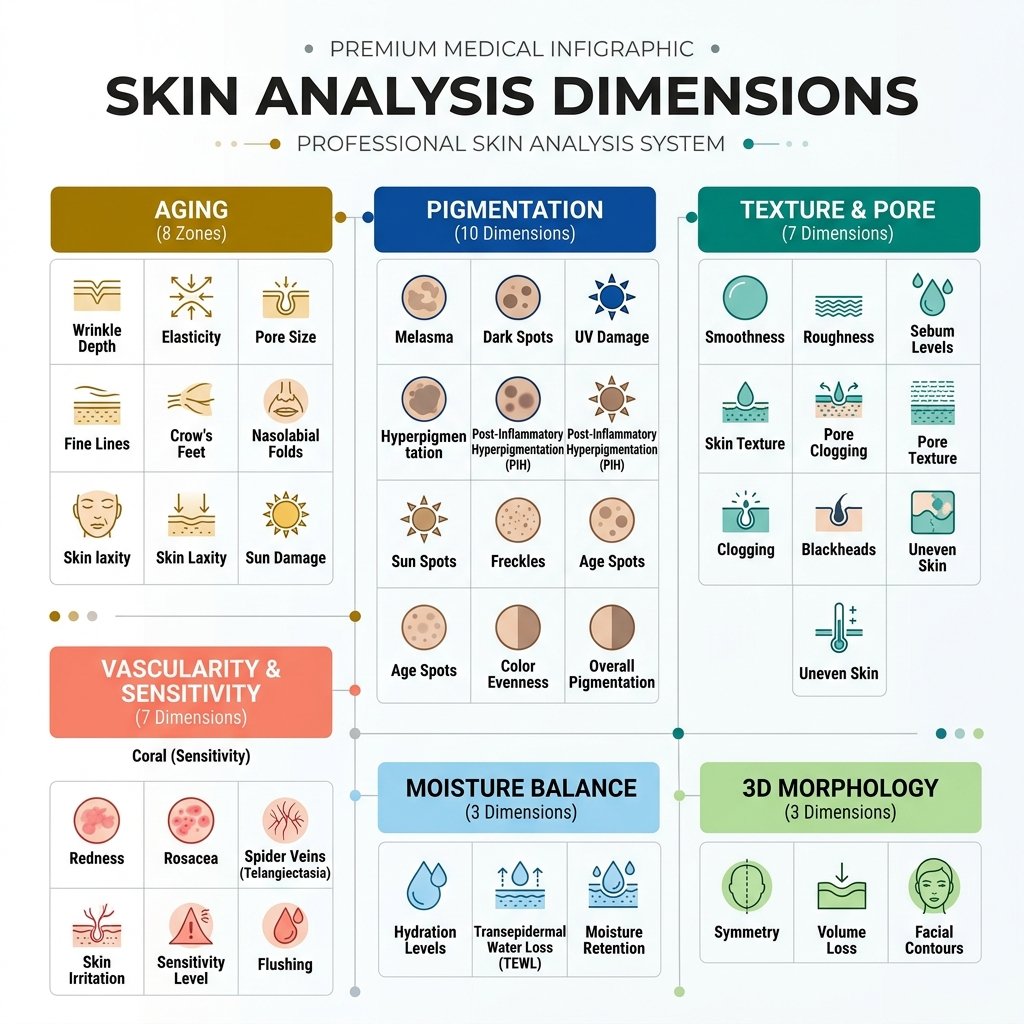
38-Dimension Skin Analysis Matrix

The AI engine analyses both 2D spectral images and the 3D mesh to generate quantified scores across 6 categories — the most comprehensive analysis available for Indian skin.

38 Skin Analysis Dimensions
Aging 8

Wrinkle depth, fine lines, crow's feet, forehead lines, nasolabial folds, marionette lines, glabellar lines, skin laxity — per-zone scoring with temporal tracking

Pigmentation 10

Spots, freckles, UV damage, melasma depth (India-exclusive), PIH grading, hyperpigmentation zone mapping, colour evenness — 6 dimensions are India-exclusive

Texture & Pore 7

Pore size distribution, sebum level, blackheads, surface roughness, texture uniformity, skin smoothness index, comedone detection

Vascularity 7

Redness zones, rosacea grading, spider veins, erythema index, sensitivity score, flushing pattern, vascular lesion mapping using Red + CPL channels

Moisture 3

Moisture balance zone map (Corneometer-equivalent), oil-moisture ratio (T-zone vs U-zone), dehydration surface index from NIR light scatter

3D Morphology 3

Facial symmetry score (106-landmark analysis), Golden Ratio indices (horizontal thirds + vertical fifths), volume delta map for filler tracking

🇮🇳 India-Exclusive Innovation

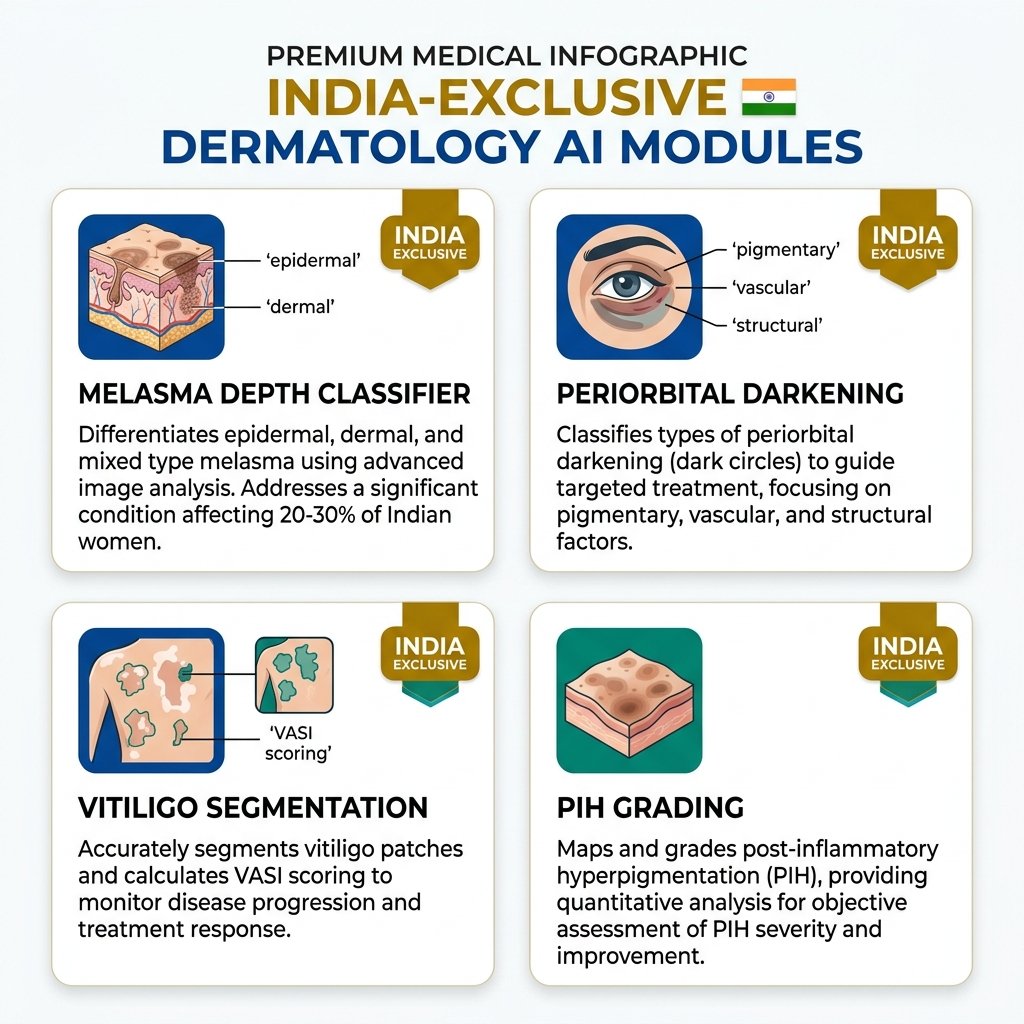
4 India-Exclusive AI Modules

These modules address India's most prevalent skin conditions — conditions that no global device (VISIA, Observ, Canfield VECTRA) has any capability to detect or classify.

India-Exclusive AI Modules
India Only

Melasma Depth Classifier

Classifies epidermal vs dermal vs mixed melasma using UV fluorescence + Brown channel analysis. Treatment depends entirely on depth — yet no device automates this.

20–30% of Indian women affected
India Only

Periorbital Darkening

Classifies dark under-eye circles as Pigmentary, Vascular, Structural, or Mixed — #1 aesthetic complaint in Indian cosmetic dermatology consultations.

5-point PDG Scale (IADVL)
India Only

Vitiligo Segmentation

U-Net segmentation on CPL + monochrome fusion. Calculates VASI proxy score. Tracks expanding / stable / repigmenting across visits.

1–2% prevalence (highest globally)
India Only

PIH Grading & Mapping

Modified MASI-PIH score (0–32) automated from Brown heatmap. Cross-references with acne lesion map to identify ongoing PIH-generating events.

Most common FST IV–VI complication
Technical Architecture

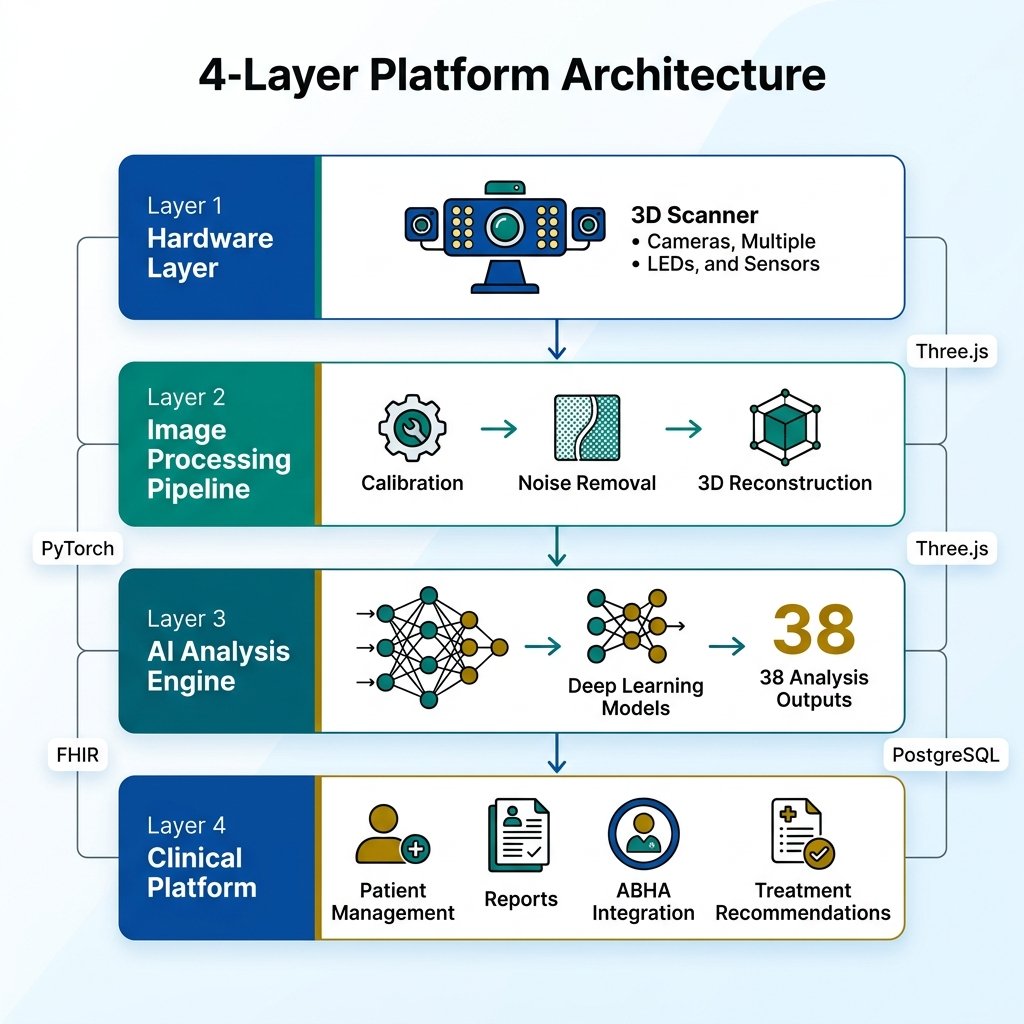
4-Layer Integrated Platform

Hardware, image processing, AI analysis, and clinical platform — each layer independently scalable and communicating via standardised APIs.

4-Layer Platform Architecture

Layer 1 — Hardware

3 stereo cameras (4K each) + 850nm ToF + 650nm laser grating. 42MP full-face, USB 3.2 Gen 2 (10 Gbps). India-calibrated LED array.

Layer 2 — Image Processing

Dark-frame subtraction, flat-field correction, FST-adaptive exposure, colour calibration (3×3 CCM), 3D mesh reconstruction (Kalman filter fusion).

Layer 3 — AI Analysis

ResNet-50 backbone + 10 task-specific analysis heads. ONNX Runtime + TensorRT. 38 quantified dimensions. India-trained on 8,000+ cases.

Layer 4 — Clinical Platform

Three.js 3D viewer, report engine (8 templates), treatment recommender (200+ IADVL protocols), ABHA integration, multi-language support.

Deployment Flexibility

Three Deployment Modes

Mode A: Clinical Workstation

Hospital OPD / dermatology clinic setup with local GPU inference.

  • USB 3.0 to dedicated workstation (Win 11 / Ubuntu 22.04)
  • AI on local NVIDIA RTX 4070 GPU
  • Dual-monitor: scan view + report/consultation
  • Reports synced to cloud EMR + ABHA locker

Mode B: Cloud-Hybrid

Aesthetic clinics & Tier 2 cities — SaaS model, no local GPU needed.

  • Images sent to Prana Cloud (AWS Mumbai)
  • AI results in < 10 seconds on 4G/5G
  • DPDP Act 2023 compliant — Indian data centres
  • Subscription SaaS model

Mode C: MSR Pod Clinic

Compact DermVision Mini embedded in MSR kiosk — nurse-operated.

  • Handheld / desktop-sized version in MSR kiosk
  • Scan in 8 sec, AI report in 30 sec
  • Triage report for dermatologist escalation
  • Integrated with ABDM workflow
Why DermVision 3D

Competitive Advantages

What makes Prana DermVision 3D fundamentally different from every global skin analysis system on the market.

India-First Calibration

Hardware-level photometric recalibration for FST III–VI. Adaptive exposure per spectral channel. No Western device does this.

38-Dimension Analysis

Most comprehensive skin analysis available — 6 categories, 38 quantified scores. 10 pigmentation dimensions (6 India-exclusive).

True 3D + Spectral Fusion

250,000-vertex facial mesh at 0.15mm precision. Spectral channels overlaid on 3D model for volumetric analysis unavailable in 2D systems.

Treatment Recommender

200+ IADVL-validated treatment protocols mapped to AI findings. No global device has an integrated evidence-based treatment advisory engine.

ABDM-Native Integration

Reports pushed to ABHA health locker. FHIR R4 DiagnosticReport. DPDP Act 2023 compliant from Day 1. Aadhaar eSign on reports.

Multi-Language Reports

AI-translated reports in English, Hindi, Kannada, Tamil, Telugu, and Marathi. Medical terminology reviewed by specialists.

Market Comparison

Prana vs Global Competitors

How Prana DermVision 3D compares to leading international skin analysis platforms.

FeaturePrana DermVision 3DChineseVCAREVISIA (Canfield)Observ 520x
3D Facial Mapping✅ 0.15mm precision + ToF✅ 0.2mm❌ 2D only❌ 2D only
Spectral Channels✅ 12 channels + NIR 850nm4 channels6 channels5 modes
Analysis Dimensions✅ 38 dimensions30+ dimensions~12 dimensions~8 modes
Indian Skin Calibration✅ FST III–VI native❌ Global only❌ Western-trained❌ Not calibrated
Melasma Depth Detection✅ Epidermal / Dermal / Mixed❌ None❌ None❌ None
Vitiligo / PIH Modules✅ VASI + PIH grading❌ None❌ None❌ None
Treatment Recommender✅ 200+ IADVL protocols❌ None❌ None❌ None
ABDM / ABHA Integration✅ Native FHIR R4❌ None❌ None❌ None
Multi-Language Reports✅ 6 Indian languagesEnglish + ChineseEnglish onlyEnglish only
Volume Delta Tracking✅ 0.1ml precision✅ 0.1ml❌ None❌ None

Transform Your Dermatology Practice

Join the Prana DermVision 3D early access programme. India's most advanced AI-powered 3D skin analysis platform — built for Indian skin, by Indian clinicians.

Request a Demo Explore Prana AI Platform